
Why is my lawn yellow in spring? Fairhaven, MA Guide
Updated: Apr 2
by Jorge Melo
You were expecting your lawn to green up, and instead it's still patchy and yellow. Some parts came back, others look thin and weak, and you can't tell if it's fungus, dormancy, bad soil, or something you did.
Here's the short answer: in Fairhaven and across the South Coast, spring yellowing is most often caused by saturated soil, nutrient deficiency, snow mold carryover, or compaction from a long-wet winter.
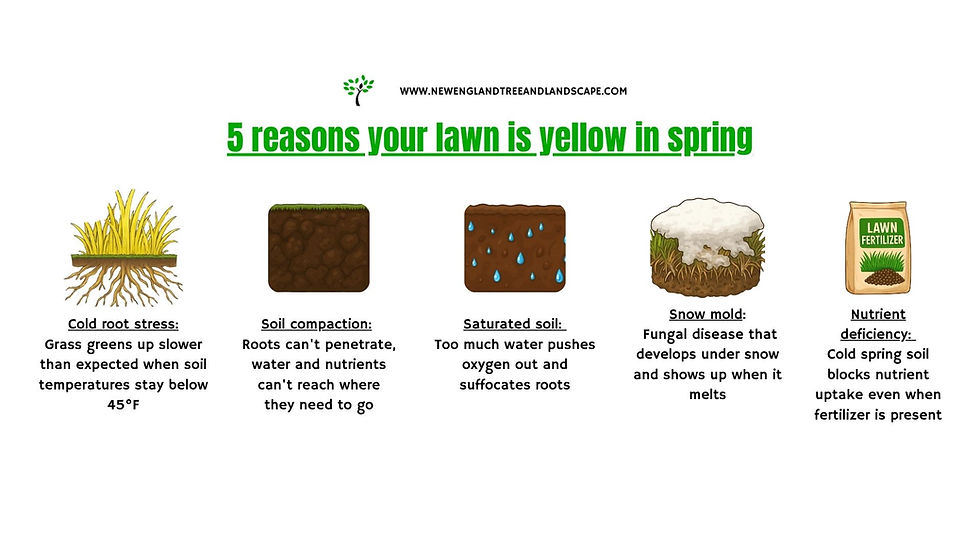
Cold spring soil slows root activity and nutrient uptake even when everything else looks fine. Shaded and low-lying areas go yellow first because they stay wet and cold the longest.
In most cases the grass is not dead. It's stressed. Identifying the right cause is what determines whether you need to fertilize, adjust watering, aerate, treat for disease, or reseed. This guide covers each cause and what to do about it.
The most common reasons grass turns yellow in spring
Nutrient deficiency in the soil
Grass needs a steady supply of nutrients to stay green. When those nutrients are missing or unavailable, the first sign is usually a shift in color: pale green, then yellow.
Lack of nitrogen
Nitrogen is the primary driver of green color and leafy growth. Without enough of it, grass fades to yellow starting at the bottom of the blades. This is especially common after a wet spring, when heavy rain flushes nitrogen out of the soil before roots can absorb it.
Lawns in Fairhaven and along the South Coast are particularly prone to this because sandy coastal soils don't hold nutrients well. A spring fertilizer application timed to the grass's growth cycle is the most direct solution.
Our lawn fertilizing program runs six stages throughout the year, starting with an early spring application designed specifically for this problem.
Iron deficiency (iron chlorosis)
Iron deficiency causes yellowing that starts at the tips of grass blades rather than the base, which is the opposite of nitrogen.
Grass with iron chlorosis looks pale at the top while lower blades may still hold some color. This often happens when soil pH is too low (acidic), because iron becomes chemically unavailable even when it's present in the soil.
Most lawns in Fairhaven, Acushnet, and the surrounding area run acidic, often below 6.0 pH.
Learn more about when to add lime to your lawn in Massachusetts to correct this.
Too much or too little water
Overwatering
Overwatering is a surprisingly common cause of yellow grass, and it's especially easy to do in spring without realizing it. A lot of homeowners keep their irrigation schedule running through wet stretches, not accounting for the rain that's already falling.
Too much water pushes oxygen out of the soil, which suffocates roots and prevents nutrient uptake. It also creates ideal conditions for fungal diseases, which cause their own yellowing.
Soggy lawns that stay wet for days after rain are particularly at risk. Many properties we work on in East Fairhaven and along Sconicut Neck Road sit over clay-heavy or compacted subsoil that holds water instead of draining it. If your lawn stays spongy for days after every storm, poor drainage is contributing to the problem.
Drought stress
On the flip side, too little water causes grass to lose color quickly. Drought-stressed turf goes pale green first, then yellow, and eventually brown if conditions don't improve.
Even in spring, dry spells can stress lawns that haven't recovered from winter dormancy. Watering deeply and infrequently, rather than with light daily watering, encourages roots to grow down into the soil where moisture is more stable.
Soil problems that cause yellow grass
Soil compaction
Compacted soil is one of the most common lawn problems across Fairhaven, New Bedford, and Acushnet, and one of the most overlooked. When soil particles get pressed together by foot traffic, mowing, and freeze-thaw cycles, roots can't penetrate deeply.
Water and nutrients can't reach where they need to go either. Grass grown in compacted soil shows up thin, weak, and yellow, particularly in high-traffic areas.
Annual aeration and overseeding breaks up compaction and creates space for roots to grow.
Poor drainage or standing water
Areas where water pools after rain cause yellow patches even if the rest of the lawn looks fine.
Glacial hardpan, a dense layer of compressed soil and till that sits roughly 12 inches below the surface in much of Fairhaven, Dartmouth, and Acushnet, stops water from draining down.
When water hits that layer, it backs up and saturates the root zone. Grass sitting in standing water for more than a day or two will start to yellow. Addressing drainage at the root cause is the only permanent fix.
Soil pH imbalance
Soil pH affects how well grass roots can absorb nutrients. When pH drops too low (acidic), nutrients like iron and phosphorus become locked in the soil. Applying fertilizer to an acidic lawn is like throwing money away. The grass can't use it.
Most Fairhaven and Acushnet lawns have acidic soil, especially near wooded areas with pine trees. A lime application raises pH back into the ideal range of 6.5 to 7.0.
Thatch buildup
Thatch is the layer of dead grass stems, roots, and organic debris that accumulates between the soil and the grass blades. A thin layer is fine. Once it exceeds half an inch, it starts blocking water, air, and fertilizer from reaching roots.
Grass roots may also start growing into the thatch layer instead of the soil, which makes them far more vulnerable to heat, drought, and disease. If you've been fertilizing and watering consistently but the lawn still looks yellow or patchy, thatch may be the culprit.
Find out more about when to dethatch your lawn in Massachusetts, or learn what's involved with our lawn dethatching services.
Lawn care mistakes
Cutting grass too short
Mowing too low removes too much of the grass blade, which reduces the leaf surface available for photosynthesis.
The grass fades to yellow and becomes more vulnerable to pests, disease, and weeds. For cool-season grasses common in Massachusetts, the recommended height is 3 to 4 inches.
Never remove more than one-third of the blade in a single mow.
Dull mower blades
Dull blades don't cut. They tear. Torn grass ends fray and dry out, giving the lawn a yellowish, hazy look that homeowners often mistake for disease or drought stress. Sharpening blades once or twice a season makes a noticeable difference in how the grass looks.
Overfertilization
Too much fertilizer, especially nitrogen, burns grass. This is a common spring mistake: homeowners put down fertilizer early in the season hoping to speed up green-up, and instead end up with yellow or orange streaks where the spreader passed, or brown patches in areas where product pooled.
If you recently fertilized and the lawn looks worse than before, fertilizer burn is worth suspecting. Using a slow-release granular fertilizer and calibrating your spreader correctly prevents this.
Misuse of lawn chemicals
Herbicides, pesticides, and deicers can all burn or kill grass if misapplied. Contact herbicides that drift onto turf, deicing salts that wash across the lawn in late winter, or concentrated pesticide applications in one spot can all cause yellow or dead patches. Rinsing the area with water helps dilute the damage.
Pests that damage grass roots
Grubs
Grubs are the most destructive lawn pest on the South Coast. They're the larval stage of Japanese beetles, June beetles, and chafers. These C-shaped white larvae live in the soil and feed on grass roots.
Once the roots are eaten away, grass can't take up water or nutrients, and it yellows and dies. Turf damaged by grubs often peels back like carpet. If you're noticing skunks or raccoons digging up your lawn overnight, that's a strong indicator grubs are present underneath.
The best approach is preventive treatment in June or July.
For detailed guidance, read our post on how to get rid of grubs in your lawn, or learn about our lawn pest control programs.
Chinch bugs
Chinch bugs pierce grass stems and inject a toxin that turns the grass yellow. The damage looks similar to drought stress, but doesn't recover with watering. They're most active during hot, dry summers and target sunny areas first. Treatment in June catches the first generation before they spread.
Lawn diseases that cause yellow patches
Several fungal diseases cause yellow patches before the grass turns fully brown.
Dollar spot creates small silver-dollar-sized yellow or tan spots.
Red thread gives grass a pinkish-yellow appearance.
Leaf spot causes irregular yellow patches that eventually collapse.
These diseases thrive in wet, humid conditions, the kind of spring weather that's common across Fairhaven and New Bedford. Improving airflow, mowing at the right height, and avoiding overwatering all reduce disease pressure.
For active infections, fungicide treatment may be needed. Read our full guide on how to get rid of lawn fungus in Fairhaven, MA, or visit our lawn disease treatment page.
Pet damage
Dog urine spots
Dog urine contains urea, a concentrated form of nitrogen. In small amounts it fertilizes the grass. In the amounts deposited repeatedly in the same spot, it burns it. Yellow or brown patches surrounded by a ring of darker green grass are the classic sign of dog urine damage.
The solution is to water the spots thoroughly to dilute the nitrogen, and reseed if the grass doesn't recover.
For more on keeping pets and lawn treatments compatible, read how long to keep dogs off a fertilized lawn.
Shade problems
Grass needs sunlight to photosynthesize. In heavily shaded areas under large trees or near structures, grass slowly thins and yellows. This is often the first place homeowners notice yellowing in spring because shaded areas stay wetter and colder longer, which slows green-up significantly.
Over time, bare spots develop. Raising the mowing height in shaded areas, pruning branches to allow more light through, and overseeding with shade-tolerant grass varieties can help. In some cases, ground cover is a better long-term solution than trying to grow turf in deep shade.
Seasonal dormancy and winter stress
Some yellowing in early spring is just dormancy, and the grass will come back on its own. Cool-season grasses like tall fescue and Kentucky bluegrass go partially dormant when soil temperatures drop below 45°F.
The grass isn't dead. It's conserving energy. This type of yellowing resolves on its own as temperatures warm and growth resumes in March and April. The question most homeowners ask is whether the slow spots are dead or just slow to wake up.
If the grass pulls out easily with no resistance, the crowns are likely dead and the area needs reseeding. If the plant is still rooted and firm, give it more time. One spring issue specific to Massachusetts is snow mold, a fungal disease that develops under snow cover and shows up as matted, tan or grayish patches when the snow melts.
UMass Extension flags it as one of the more common early-spring lawn problems in the state. Light raking breaks up the matted grass and improves airflow, which helps the lawn recover faster. Lawns that were stressed heading into winter, from drought, disease, or grub damage, come out of dormancy looking worse and may need overseeding and fertilization to recover.
How to make yellow grass green again
Improve soil health
Start with a soil test. This tells you the actual pH and nutrient levels, rather than guessing. Lime corrects acidic soil, compost improves drainage and structure, and targeted fertilizer fills in specific deficiencies.
Apply proper fertilization
A spring fertilizer with nitrogen and iron addresses the two most common causes of yellowing. Match the product to your soil test results. Use slow-release granular formulas to avoid burning the grass. Timing matters: apply too early and cold soil can't absorb it effectively.
Our lawn fertilizing program matches each application to the season and what the grass actually needs at that point in the year.
For more on scheduling, read how often you should fertilize your lawn in Massachusetts.
Fix watering issues
Most established lawns need about 1 inch of water per week. Water deeply once a week rather than lightly every day.
Deep watering encourages roots to grow downward, which builds resilience. If parts of the lawn stay wet regardless of how you water, drainage is the real issue.
Aerate compacted soil
Core aeration pulls plugs of soil from the ground, breaking up compaction and opening the surface to air, water, and nutrients.
Fall is the best time on the South Coast, when cool-season grasses grow aggressively and recover fast.
Spring aeration also works for lawns that are severely compacted.
Dethatching the lawn
If thatch has built up past half an inch, a power rake removes the accumulated debris and opens the soil surface.
This is typically needed every 3 to 5 years.
Read what is lawn thatching and does your Fairhaven, MA lawn need it to determine whether your lawn needs it.
You can also review whether to aerate or dethatch first before scheduling service.
Overseed thin or damaged areas
Yellow patches that don't recover after addressing the cause need new seed. Overseeding spreads seed over the existing lawn.
For areas with significant bare ground, more than 30%, lawn slice seeding cuts directly into the soil and deposits seed at the right depth for a much higher germination rate.
Lawn care best practices to prevent yellow grass
Mow at the proper height
Keep cool-season grasses at 3 to 4 inches. Taller grass shades the soil, holds moisture better, and is less vulnerable to drought, pests, and disease. Mow regularly enough that you never remove more than one-third of the blade in a single cut.
Our lawn mowing service adjusts cutting height by season.
Keep mower blades sharp
Sharpen blades at least once a season, or whenever the cut starts looking ragged. A sharp blade makes a clean cut that heals quickly.
A dull blade tears the tissue, leaving the grass susceptible to disease and giving it a yellowish appearance.
Water deeply but infrequently
Daily light watering keeps roots shallow and near the surface, where they dry out fast and are more vulnerable to heat stress. Watering deeply once a week trains roots to follow moisture downward.
Early morning watering is best. It reduces evaporation and dries the grass surface before nightfall, which reduces fungal disease risk.
Fertilize at the right time of year
Fertilizing at the wrong time wastes product and can damage the lawn. In Massachusetts, the major application windows are early spring, late spring, summer, and fall.
A late-fall winterizer is especially important. It helps the grass store carbohydrates through dormancy so it comes out of winter stronger. Missing this application is one of the most common reasons lawns look rough the following spring.
When is the best time to grow grass seed in Massachusetts?
Late August through mid-October is the best window for seeding in Massachusetts. Soil is warm enough for quick germination, air temperatures are cooling down, and fall rains provide consistent moisture.
Spring seeding works but competes with crabgrass and early weeds, and the narrow window before summer heat arrives makes establishment harder.
If your lawn has yellow or bare patches from this spring, plan for a fall overseeding or slice seeding after addressing the underlying cause.
Why yellow lawns are common on the South Coast of Massachusetts
Lawns across Fairhaven, New Bedford, Acushnet, and the surrounding South Coast face a combination of conditions that make consistent turf harder to maintain than it looks. That unevenness, green in some spots and yellow in others with no obvious explanation, often comes down to soil variation across the same yard.
Sandy soils in coastal areas near Buzzards Bay drain fast and flush nutrients with every rain. Clay-heavy soils further inland, especially in Acushnet Center and North Fairhaven, compact easily and can hold too much moisture after storms. Glacial hardpan, sitting roughly 12 inches below the surface in much of this area, stops downward drainage entirely and creates chronic wet spots.
Spring on the South Coast brings its own challenges. The March through May thaw window is when snowmelt and heavy spring rains hit ground that's still cold from winter. Nor'easters can drop several inches of rain in 24 to 48 hours, overwhelming drainage and leaving lawns saturated for days. Lawns that went into winter stressed, from a dry summer, grub damage, or skipped fall treatments, come out looking their worst.
In our 35+ years working on lawns across Fairhaven, East Fairhaven, Sconicut Neck Road, New Bedford, the North End and South End of New Bedford, Howland Mill, Acushnet Heights, and Acushnet Center, the same pattern comes up repeatedly: lawns that struggle year after year usually have an underlying soil problem that needs to be fixed before anything else will stick.
Fertilizer won't help if the pH is wrong. Watering won't help if drainage is the problem. Getting the diagnosis right first is what makes treatment work.
Our lawn care services in Fairhaven, MA, and lawn care services in New Bedford, MA are built around local conditions, not generic programs from a national company.
Request a lawn evaluation in Fairhaven, MA
If your lawn is yellow this spring and you're not sure why, the most useful thing you can do is have it looked at in person.
Yellow grass can come from a dozen different causes, and treating the wrong one wastes time and money.
New England Tree & Landscape serves Fairhaven, North Fairhaven, East Fairhaven, Sconicut Neck, New Bedford, the South End of New Bedford, Howland Mill, Acushnet Heights, Acushnet, and Acushnet Center.
Call 508-763-8000 or email request@newenglandtreeandlandscape.com to schedule your free lawn evaluation.
We'll walk your property, identify what's causing the problem, and give you a clear plan with no pressure and no guesswork.
Frequently asked questions about yellow grass
What type of fertilizer helps restore yellow grass?
A balanced fertilizer with a higher nitrogen content is the most common fix for general yellowing. If iron deficiency is the issue, look for a fertilizer that includes iron or apply an iron supplement separately. Always conduct a soil test first so you're addressing the actual deficiency and not guessing. Slow-release granular fertilizers are safer than quick-release products because they feed the grass steadily without burning.
Our lawn fertilizing program in Fairhaven uses slow-release formulas timed to each growth stage.
Do dull mower blades make grass look yellow or damaged?
Yes. Dull blades tear rather than cut grass, leaving ragged ends that dry out and fray. The result is a yellowish, hazy appearance across the lawn that can look like disease or drought stress. Sharpening blades once or twice per season resolves this. If the yellowing appears uniformly across the whole lawn shortly after mowing, dull blades are often the cause.
Does yellow grass mean there is a problem with the soil?
Often, yes, but not always. Soil problems like low pH, compaction, poor drainage, or nutrient deficiency are among the most common causes of yellow grass.
However, yellowing can also come from pest damage, disease, overwatering, or dormancy. A soil test is the most reliable way to rule soil issues in or out. Lawns in Acushnet and Fairhaven frequently test acidic, which locks nutrients in the soil even when fertilizer has been applied.
Can lawn diseases cause grass to turn yellow before it turns brown?
Yes. Dollar spot, red thread, and leaf spot all cause yellow patches in early stages before the grass progresses to tan or brown.
These diseases are common in the wet, humid spring conditions across New Bedford and Fairhaven. If you notice irregular yellow patches with distinct borders or any visible pink or red coloring in the grass, disease is a likely cause.
Read our guide on how to get rid of lawn fungus in Fairhaven, MA for identification and treatment information.
Will grass grow back after fertilizer burn?
Mild fertilizer burn often recovers with deep watering to flush excess salts from the root zone. Severe burn that kills the grass down to the roots won't recover and will need reseeding. The recovery timeline depends on how much damage occurred. Watering the affected area thoroughly immediately after noticing burn gives the grass the best chance. Prevent fertilizer burn by calibrating your spreader correctly and using slow-release products.
Why does grass turn yellow in shady areas of the yard?
Shade reduces the sunlight available for photosynthesis. Grass in heavily shaded areas can't produce enough energy to stay dense and green, so it slowly thins and yellows. Raising mowing height in shaded spots helps the grass capture more available light. Pruning overhanging branches can increase light penetration significantly. Overseeding with shade-tolerant varieties like fine fescue improves long-term coverage in low-light areas.
Could grubs or other lawn pests be causing yellow patches in my grass?
Yes. Grubs eat grass roots from below the soil surface, cutting off the plant's ability to take up water and nutrients.
Yellow patches from grub damage feel spongy or loose underfoot, and damaged turf often pulls back like a rug. Skunks and raccoons digging into the lawn overnight are a reliable sign.
Chinch bugs cause surface yellowing that resembles drought stress but doesn't respond to watering.
Our lawn pest control service covers both, and preventive grub treatment in June or July is far more effective than reacting after damage appears.
Why does grass turn yellow after a long stretch of hot weather?
Heat stress occurs when temperatures stay high and soil moisture drops. Cool-season grasses common in Massachusetts aren't built for sustained high heat.
They slow growth, lose color, and may enter partial dormancy as a survival response. This is normal and usually temporary. Deep watering during dry stretches and avoiding mowing during the hottest part of the day reduces stress. Lawns with compacted soil or thatch buildup suffer more during heat events because water and nutrients can't reach the roots.
Should yellow lawn patches be reseeded immediately or allowed time to recover?
It depends on the cause. If the grass is dormant or mildly stressed from weather, give it time to recover before seeding. Seeding into dormant grass often fails because conditions aren't right for germination. If the cause was pest damage, disease, fertilizer burn, or pet urine and the grass crowns are dead, reseeding is needed. Correct the underlying cause first, then seed. Fall is the best window for successful establishment in Massachusetts.
When should damaged yellow grass be replaced instead of waiting for it to recover?
If more than 40 to 50 percent of the lawn is dead or bare ground, recovery through overseeding alone is unlikely to produce good results. At that point, lawn slice seeding, which cuts into the soil and deposits seed directly, gives much higher germination rates. For very large areas with complete grass loss, sod may be the faster and more reliable option. We assess this during free lawn evaluations across Fairhaven, Acushnet, and New Bedford.
How long after a lawn treatment is it safe for pets to go back on the grass?
Most granular fertilizer treatments are safe once they've been watered in and the lawn surface is dry, typically within 24 to 48 hours. Liquid treatments and herbicides vary by product, so always follow label instructions.
For detailed guidance, read how long to keep dogs off a fertilized lawn. When in doubt, ask your lawn care provider for the specific product used and its re-entry interval.
When is the best time to apply GrubEx in Massachusetts?
GrubEx and similar preventive grub control products should be applied between late May and early July in Massachusetts, before Japanese beetle eggs hatch in midsummer. Once grubs have hatched and grown past their early larval stage, preventive products are far less effective. Applying early in the window, May through June, gives the product time to move into the soil before eggs hatch.
Our lawn pest control program handles preventive grub treatment on a timed schedule so this window is never missed.
Does New England Tree & Landscape offer lawn services in my area?
We serve communities across the South Coast of Massachusetts, including Fairhaven, East Fairhaven, North Fairhaven, Sconicut Neck Road, New Bedford (including the North End, South End, Howland Mill, and Acushnet Heights), Acushnet, Acushnet Center, Mattapoisett, Dartmouth, Marion, and Rochester.
If you're unsure whether we cover your address, call 508-763-8000 and we'll confirm.
What makes New England Tree & Landscape different from other lawn care companies?
We've been working on South Coast lawns for over 35 years. That matters because this area has specific soil and drainage conditions, including glacial hardpan, sandy coastal soils, and acidic pH from pine needle accumulation, that affect how lawns respond to treatment. Generic national programs aren't built for these conditions.
Our team walks each property, identifies the actual cause of the problem, and builds a program around what that specific lawn needs. We don't sell unnecessary services.
Do you offer free estimates for lawn care?
Yes. We offer free lawn evaluations for all properties in our service area. During the evaluation we'll identify current problems, explain the likely causes, and walk you through the recommended services.
Contact us at 508-763-8000 or request@newenglandtreeandlandscape.com to schedule.
Sources
Marino, Mark. "Why Is My Grass Turning Yellow? (This is Why Your Grass is Not Green)." Lawn Phix, 15 July 2020, updated 29 December 2023. https://lawnphix.com/why-is-my-grass-turning-yellow/
Purnell, Jane. "Yellow Grass: Causes and Treatment." LawnStarter, updated 14 December 2024. https://www.lawnstarter.com/blog/lawn-care/yellow-grass-causes-treatment/
"Why Is My Grass Turning Yellow?" Monnick Supply, 21 June 2022. https://www.monnicksupply.com/blog/why-is-my-grass-yellow/
"How to Fix and Prevent a Yellow Lawn." Emerald Lawns, 24 August 2017. https://emeraldlawns.com/how-to-fix-and-prevent-a-yellow-lawn/
"Lawn Care: Why Is My Grass Turning Yellow." Hartney Greymont, 15 August 2024. https://www.hartneygreymont.com/resources/lawn-care-why-is-my-grass-turning-yellow/
"Lawn Care Service in Fairhaven, MA." New England Tree & Landscape, 2024. https://www.newenglandtreeandlandscape.com/lawncare


Comments