
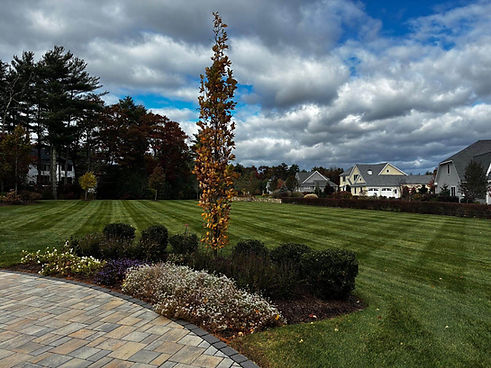
Lawn Care Service in Fairhaven, MA
Lawns rarely fail overnight. Grass slowly thins, weeds start spreading, and patches appear because problems like poor soil, inconsistent mowing, and missed seasonal treatments go unnoticed until the damage is obvious.
New England Tree & Landscape provides professional lawn care across Fairhaven and the South Coast that keeps turf healthy through consistent service and treatments built for local conditions. By addressing issues early, lawns stay thick, green, and resilient instead of declining season after season.
Call 508-763-8000 or email request@newenglandtreeandlandscape.com to request a free estimate.
Our Lawn Care Programs
Thirty-five years and countless lawns across the South Coast. That is how long we have been solving the exact problems your property is dealing with right now. Sandy soil near the water that loses nutrients after every rain, clay soil inland that compacts and suffocates roots, crabgrass every summer, grubs cycling through, fungus as soon as humidity builds.
Most lawn problems come down to the same things: wrong fertilizer timing, skipping aeration, letting weeds establish before treating them, or ignoring pest problems until the damage is done. Staying ahead of these problems is always cheaper and faster than reacting after the grass is already gone. That is why most of our customers are on scheduled programs.
Our programs cover everything your grass needs throughout the year. Weekly mowing at the right height. Fertilizer is timed to each stage of the growing season. Pre-emergent and post-emergent weed control. Grub prevention and insect treatment. Disease control when the fungus shows up. Aeration and overseeding to build density.
Additionally, we prep your lawn for winter, including late-season fertilization, final mowing height to prevent snow mold, and cleanup so turf goes into the cold months strong.


Commercial Lawn Care
Commercial properties require consistent lawn maintenance to stay safe, accessible, and professional-looking throughout the growing season. Office buildings, retail plazas, apartment complexes, medical offices, and industrial properties cannot afford missed service visits or overgrown turf.
New England Tree & Landscape provides commercial lawn care services across the South Coast, including communities throughout Bristol County and Plymouth County such as Fairhaven, New Bedford, Dartmouth, Acushnet, Mattapoisett, Marion, and Rochester.
Commercial lawn care typically includes scheduled mowing, trimming, edging, fertilization, weed control, aeration, and overseeding to maintain healthy turf and a clean appearance. Many commercial clients combine lawn care with landscaping maintenance, such as mulching, shrub trimming, and seasonal cleanups so the entire property stays maintained.
Reliability matters more than anything for commercial sites. Our crews follow scheduled maintenance routes so service happens consistently and properties remain maintained throughout the season.
Residential Lawn Care
Residential lawn care focuses on keeping home lawns healthy, consistent, and well-maintained throughout the growing season. Grass on residential properties deals with constant stress from weather, foot traffic, pets, insects, and soil conditions common across the South Coast.
New England Tree & Landscape provides residential lawn care services throughout Fairhaven, New Bedford, Mattapoisett, Dartmouth, Acushnet, Marion, and Rochester. Our programs are built around the conditions common to coastal Massachusetts, where sandy soils lose nutrients quickly, and inland clay soils compact easily.
Residential lawn care typically includes mowing, fertilization, weed control, aeration, overseeding, pest management, and seasonal preparation. These services work together to maintain dense, healthy turf while preventing the weeds, insects, and disease problems that cause lawns to decline over time.
Many homeowners choose full lawn care programs that keep their grass maintained throughout the season, while others hire us for individual services such as mowing, fertilization, or aeration, depending on the condition of the lawn.

Lawn Mowing & Maintenance
We mow at the right height for the time of year. Taller in summer to shade roots and reduce heat stress. Shorter in spring and fall when cooler temperatures allow it.
Every visit includes edging along walkways and beds, trimming around obstacles, and blowing off hard surfaces.
Most residential properties need weekly mowing from April through October. In May and June, when growth is heaviest, some properties need twice a week.
During dry stretches in July and August, we adjust the schedule based on how the grass is actually growing.
We handle mowing for homeowners across Fairhaven, New Bedford, Mattapoisett, and Dartmouth who want reliable weekly service, whether that is part of a full lawn care program or just mowing on its own.


Lawn Fertilizing
Applying the right nutrients at the right times ensures your grass stays healthy and green. Nitrogen for growth and green color, phosphorus for root development, and potassium for stress tolerance and disease resistance.
We run a six-stage fertilization program throughout the year, each application timed for what the grass needs at that point in the season. Missing applications or applying at the wrong times means grass doesn't get what it needs when it needs it.
We apply granular fertilizer that releases slowly over several weeks. Quick-release fertilizers burn grass or wash away before plants use them. Slow-release feeds grass consistently without spikes that cause excessive growth or waste.
Stage 1: Early Spring (February-March) Gets grass growing after winter using balanced slow-release fertilizer. We include crabgrass pre-emergent because timing matters. Crabgrass germinates when soil hits certain temperatures and you need preventer down before that happens.
Stage 2: Late Spring (April-May) Keeps grass fed during heavy growth period. We add iron to boost color and density. Light weed treatment eliminates broadleaf weeds before they spread.
Stage 3: Early Summer (June-July) Helps grass handle heat stress using fertilizer higher in potassium. Includes insect and grub control when chinch bugs and ants become active.
Stage 4: Late Summer (August) Maintains color and strength during dry months using slow-release fertilizer. Avoids over-application because too much nitrogen burns grass when temperatures spike.
Stage 5: Early Fall (September-October) Rebuilds roots and repairs summer damage using balanced slow-release fertilizer. Cooler air and consistent moisture make this the best growing period of the year.
Stage 6: Late Fall (November) Winterizer fertilizer helps grass store nutrients during dormancy. Ensures a fast, healthy comeback once the ground thaws in spring.
For properties where fertilizer isn't performing the way it should, we test the soil first. pH is usually the culprit. When it drops below 6.0, grass can't absorb nutrients no matter how much you apply. That's a soil problem, not a fertilizer problem, and we handle it separately as part of our lawn care program.

.jpeg)
Soil Amendments
Fertilizer won't fix a lawn that has a soil problem. If your grass stays thin and pale no matter what goes down, the issue is usually pH, low organic matter, or soil that can't hold nutrients long enough for roots to use them. That's what soil amendments correct.
Most lawns across Fairhaven and the South Coast are acidic. When pH drops below 6.0, nitrogen and phosphorus lock up in the soil and become unavailable to grass roots. Lime raises pH back into range so fertilizer can actually work. Sandy coastal properties lose nutrients too fast and need compost topdressing to build organic matter over time. Heavier inland soil sometimes needs gypsum to improve structure or address calcium deficiency without pushing pH higher.
We test the soil before recommending anything. The test tells us whether the problem is pH, calcium, organic matter, or something else entirely. Without it, you're guessing, and the wrong amendment makes the problem worse, not better.
Soil amendment applications are part of our year-round lawn care program, not a standalone service. If your lawn isn't responding to fertilizer the way it should, that's usually the first sign something is off below the surface.
Lawn Weed Control
Those dandelions you killed last month are already coming back. That is what happens when weed control stops at a bottle of Weed-B-Gone from the hardware store.
Real weed control has two parts: preventing weeds before they germinate and killing the ones that break through. We handle both across Fairhaven, Mattapoisett, Rochester, Acushnet, Marion, New Bedford, Dartmouth, and the rest of the South Coast.
Pre-Emergent Weed Control
Pre-emergent creates a barrier in the soil that stops weed seeds from sprouting. For crabgrass, this is the most important treatment of the year. We apply it in late February or March, timed to forsythia blooming, which signals that the soil is warming into the range where crabgrass germinates. Miss that window and you spend all summer fighting crabgrass instead of preventing it.
Post-Emergent Weed Control
Post-emergent kills weeds that are already growing. Dandelions, clover, chickweed, crabgrass that got past pre-emergent, and other broadleaf weeds all need post-emergent treatment. Spring applications catch weeds while they are young and easiest to kill. Fall applications are just as important because weeds that go to seed in fall come back worse the following spring. We treat as many times as needed through the season until the lawn is clean.
Selective and Non-Selective Herbicides
We use selective herbicides that kill weeds without harming your grass. Different products target different weed types, and professional application means the right product goes down at the right rate and the right time. For lawns around Fairhaven or Mattapoisett that are mostly weeds with barely any grass left, selective treatment is not enough. That is when non-selective herbicides kill everything so we can start fresh with new seed or sod. We only recommend that after explaining all your options.
The Bigger Picture
Thick, healthy grass is your best long-term weed defense. Weeds take over thin spots where grass is weak from poor fertilization, compaction, drought stress, or mowing too short. We control what is growing now while building turf dense enough to crowd out future problems on its own.
Lawn Aeration and Overseeding
If your lawn feels hard underfoot and grass looks thin, no matter how much you water and fertilize, compacted soil is probably the problem. Aeration and overseeding fix the root cause by opening up the soil and thickening the turf.
Aeration
Aeration means pulling plugs of soil out of the lawn to break up compaction. Compacted soil prevents roots from growing deep and stops water and nutrients from reaching where they need to go. We use core aerators that pull actual plugs, not spike aerators that just punch holes and make compaction worse. Heavy clay soils across Fairhaven, New Bedford, Dartmouth, and Mattapoisett compact from foot traffic, mowing, and normal use. Properties with heavy use need aeration every year. Lighter use lawns can go every other year, but skip it too long, and the soil gets so hard that watering and fertilizing barely make a difference.
We aerate primarily in the fall because that is when cool-season grass grows most aggressively and recovers fast. Spring aeration works, but fall gives better results.
Overseeding
After aerating, we spread grass seed over the existing lawn to fill in thin areas and build density. Seed falls into the aeration holes where it has direct soil contact for germination. We match seed to your conditions: tall fescue for sun, fine fescue for shade, perennial rye mixed in where quick germination helps. We may topdress with compost after seeding to improve germination and build soil quality over time.
Slice Seeding
Slice seeding cuts narrow slits into soil and drops grass seed directly into those grooves for 90% germination rates compared to 15-30% with broadcast overseeding. The blades slice through thatch and penetrate soil about 1/4 to 1/2 inch deep, placing seeds where they make direct contact with soil and stay protected from birds and runoff.
This works best for lawns showing more than 30% bare ground or thin spots where regular overseeding won't fix the problem. Properties near the coast deal with sandy soil that drains fast and coastal salt damage. Slice seeding places seed deep enough to access moisture even when surfaces dry out.
We use slice seeding when lawns need serious renovation but don't need complete replacement. Seeds germinate within 7-10 days and lawns reach 80% coverage within four weeks. Fall timing from late August through mid-October provides ideal conditions for establishment before winter.
Lawn Dethatching
Dethatching removes the thick layer of dead grass stems, roots, and organic matter that builds up between green grass blades and soil surface. When thatch exceeds half an inch, it blocks water and fertilizer from reaching roots, traps moisture that promotes disease, and causes grass to grow shallow roots into the thatch instead of soil.
We use power rakes with vertical blades that tear through accumulated thatch and pull it to the surface. The process is aggressive and makes lawns look rough immediately after, but recovery happens quickly when done during active growth periods in early fall or early spring.
Most lawns only need dethatching once every 3-5 years when thatch builds past half an inch. Properties that get regular aeration rarely develop severe thatch because the aeration process breaks up accumulation naturally. We measure thatch depth, remove excess material, haul away debris, and follow up with overseeding and fertilization to support recovery.
Canadian Geese
Geese destroy turf through heavy grazing and leave nearly a pound of waste per bird per day. Droppings contaminate grass, create health hazards, and make lawns unusable.
Properties near water in Fairhaven and Mattapoisett see the worst pressure from resident geese that no longer migrate. These birds feed on manicured lawns and nest near ponds year-round.
We apply Flight Control, an EPA-approved repellent that makes grass unpalatable through a harmless UV coating that geese can see and mild digestive irritation that conditions them to avoid treated areas.
Applications in early spring, before nesting season, work best because geese become territorial once established and are harder to move. Reapplication after mowing or heavy rain maintains protection through the season.
Treatment is legal and humane. Geese are federally protected under the Migratory Bird Treaty Act, so harming them is not allowed. Flight Control keeps them off your property without hurting the birds.
Lawn Pest Control
Lawn pests cause damage below the surface before you ever see it. By the time grass turns brown, peels up, or gets torn apart by animals digging at night, the damage is already done. Grubs, chinch bugs, ants, and Canada geese all cause serious problems across Fairhaven, Acushnet, Rochester, Mattapoisett, Marion, New Bedford, and Dartmouth, and prevention works far better than reacting after the damage shows up.
Grubs
Grubs are the biggest lawn pest problem on the South Coast. They are C-shaped beetle larvae that live in soil and eat grass roots until the turf peels up like carpet. Japanese beetles, June beetles, and chafers all produce them.
Preventive insecticide applied in June or July stops grubs before they hatch and is more effective and less expensive than curative treatment after they have already destroyed roots. Six or more grubs per square foot means treatment is needed. Skunks and raccoons digging up your lawn at night confirm they are there.
Chinch Bugs
Chinch bugs suck sap from grass blades and create dead patches in full sun areas during hot, dry summer weather. The damage looks like drought stress, but does not respond to watering. Treatment in June catches the first generation before they reproduce, with follow-up in August if populations persist.
Ants
Ants build mounds that create uneven surfaces and bare spots across the lawn. Treatment targets mounds directly with products that colony members carry back to the queen. Broadcast treatments handle properties with numerous colonies.

Lawn Disease Treatment
Lawn disease treatment addresses fungal problems that create dead or dying patches.
The most common diseases around Fairhaven are brown patch, dollar spot, and red thread. All caused by fungus that thrives in certain conditions - usually heat, humidity, and poor air circulation.
Brown patch shows up in summer during hot, humid weather. Creates circular dead areas that start small and expand outward. Grass dies from fungus infecting leaf blades and crowns. Heavy nitrogen fertilizer and overwatering make it worse.
Dollar spot creates small silver-dollar-sized dead spots across the lawn. Shows up when nights are cool and days are warm with heavy dew. Low nitrogen fertility makes lawns more susceptible.
Red thread makes grass look pinkish-tan and thin. You can see pink or red threads sticking out of grass blades. Shows up in cool, wet weather on underfed lawns.
We treat diseases with fungicides when necessary, but focus more on prevention.
'
Proper fertilizing keeps grass healthy and resistant. Not overwatering prevents conditions that fungus needs. Aerating improves air circulation. Mowing at the correct height helps grass handle stress.
Some properties get diseases every year because conditions favor them. Low spots that stay wet, heavy shade with poor air flow, and tight clay soil.
We can treat diseases, but if you don't fix the conditions causing them, they'll keep coming back
.jpeg)
Lawn Renovation
If your lawn is mostly weeds, bare soil, or keeps failing no matter what you try, basic treatments are not going to fix it. At that point, the lawn needs a full renovation, not another round of fertilizer.
Lawn renovation in Fairhaven and across the South Coast means starting over the right way. We remove the existing turf when needed, correct grading issues, address poor soil with amendments or loam, and rebuild the lawn with proper seeding or sod so it establishes evenly.
This is common on properties damaged by construction, heavy equipment, poor fill, drainage issues, or years of neglect. Trying to patch these lawns wastes time and money because the underlying problem never gets fixed.
We handle the full process from site prep to final seeding, including erosion control on slopes and correcting conditions that caused the failure in the first place. The result is a lawn that actually holds up instead of breaking down again next season.
Why South Coast Lawns Struggle
Lawns across Fairhaven, New Bedford, and the surrounding South Coast deal with a combination of local conditions that make turf harder to keep dense, healthy, and consistent. Clay-heavy soil in some areas compacts easily and blocks air, water, and nutrients from reaching the roots.
Coastal properties with sandy soil often have the opposite problem, where water drains too quickly and nutrients leach out before the lawn can use them.
On top of that, crabgrass, broadleaf weeds, grubs, fungal disease, and seasonal stress all thin turf over time.When these issues are ignored, the lawn starts to lose density, weak spots open up, and weeds move in.
Good lawn care is not just about mowing or fertilizing. It is about correcting the underlying conditions that cause lawns to struggle in the first place.
Our Lawn Care Process
Every lawn has different problems, but the process for improving turf health is usually the same.
1. Start with the right guidance
At the top of this page, you can use our Lawn Care Plan Generator to get a seasonal plan based on your ZIP code, the time of year, and your lawn goals. It is a useful starting point for understanding what your lawn may need right now.
2. Evaluate what is actually going wrong
For a more accurate plan, the lawn has to be seen in person. Thin turf, compacted soil, pH issues, grubs, disease, drainage problems, and thatch buildup can all create similar symptoms from a distance but require different solutions.
3. Correct the underlying issue
Once the cause is identified, the next step is fixing it properly. That may include aeration, dethatching, lime, fertilization, weed control, pest control, disease treatment, or drainage correction depending on the condition of the lawn.
4. Restore turf density
After the underlying problem is addressed, the lawn can be improved with overseeding, slice seeding, or sod depending on how thin the turf is and how much healthy grass remains.
This process creates stronger, healthier lawns that last, rather than short-term improvement that fades because the real problem was never fixed.
Hire New England Tree and Landscape for Lawn Care
We have been keeping lawns healthy across Fairhaven, Acushnet, Rochester, New Bedford, Mattapoisett, Dartmouth, and the South Coast for 35 years. Mowing, fertilization, weed control, pest control, aeration, overseeding, disease treatment, and seasonal prep.
We handle all of it, and we do it on a schedule, so problems get prevented instead of paid for after the fact.
You can hire us for a complete lawn care program or for individual services. Either way, we will walk your property, tell you exactly what it needs, and give you a free estimate.
Call 508-763-8000 or email request@newenglandtreeandlandscape.com. 35 years in business, local crew, family-owned. We are the caring professionals serving the South Coast of MA.
FAQ's
How frequently should lawns be fertilized in Massachusetts
Lawns in Massachusetts should be fertilized 6 times per year, spaced around the natural growth cycles of cool-season grass. That usually means early spring, late spring, early summer, late summer, early fall, and a final late-fall winterizer. Fewer applications lead to weak turf, and more than that usually does more harm than good.
When does a lawn need renovation instead of just fertilizer and weed control?
A lawn needs renovation when the underlying stand is too far gone for routine treatment to matter. UMass says complete renovation of the existing turf should be considered when the lawn is at least 50% weedy and undesirable grass species. If the real problem is poor grass type, major thinning, repeated insect or disease damage, heavy weed pressure, or bare areas that keep failing, fertilizer alone is just you paying to green up a bad lawn temporarily.
Can lawn fertilizer in Massachusetts contain phosphorus?
Yes, but not just because you feel like using it. Massachusetts restricts phosphorus on non-agricultural turf and lawns. It can be applied if a soil test shows it’s needed, or in limited establishment and renovation situations such as new lawns, patching, or renovation. For routine maintenance on established lawns, most properties should be using fertilizer with 0 phosphorus unless testing says otherwise.
Is hiring a professional lawn care service worth it?
A professional lawn care service knows when to fertilize, how much to apply, and what problems to treat before they get out of hand. Most homeowners either miss the timing, use the wrong products, or overdo it and damage the lawn. A pro saves you time, prevents expensive mistakes, and keeps the lawn consistent instead of good one month and rough the next.
What lawn care services are important during the fall season?
Fall lawn care should include aeration and overseeding, fall fertilization, leaf cleanup, and weed control. This is the best time to thicken the lawn and fix summer damage before winter sets in.
What's the difference between lawn care services and landscaping services
Lawn care focuses on the grass itself, like mowing, fertilizing, overseeding, and weed control. Landscaping covers everything else, like plants, trees, beds, drainage, patios, walkways, and the non-grass parts of your yard.
When should grub control be applied in Massachusetts?
For preventive grub control, the main target window is generally before or around egg hatch in summer, with exact timing depending on product and conditions. If you are using chlorantraniliprole, it is commonly applied earlier, in April or May, because it takes longer to move into the root zone. Curative materials are used later when damage is already present, typically late summer into early fall. Translation: if you wait until the lawn is peeling back like carpet, you are no longer doing prevention.
When should crabgrass preventer go down in Fairhaven and the South Coast?
Usually late April into early May, not based on the calendar alone, but when soil temperatures hit about 55°F for 4 to 5 straight days. UMass also points to full forsythia bloom as a solid local cue. On the South Coast, that often lands a little earlier than inland spots, so don’t wait until crabgrass is already germinating.