

Yard Grading and Lawn Leveling in Fairhaven, MA
Every time it rains, the same corner of your yard floods. The grass dies out. Mud tracks into the house. And you are starting to wonder how close that water is getting to your foundation. That is a grading problem, and reseeding or installing a French drain will not fix it.
New England Tree & Landscape reshapes properties so water drains away from your home. We use laser levels, skid steers, and quality screened loam to correct grades and level lawns across Fairhaven and the South Coast. Over 35 years in business. Local crew. Free estimates.
Call 508-763-8000 or email request@newenglandtreeandlandscape.com.
Landscape Grading and Surface Drainage
Landscape grading reshapes the ground, so water flows away from your home and toward an appropriate drainage outlet. Every property needs a positive slope away from structures. The standard is 2 percent, which is 2 inches of drop for every 10 feet of distance away from the foundation. Less than that and surface drainage stalls. Water sits instead of moving.
'
A lot of properties in Fairhaven, Acushnet, and surrounding South Coast towns were graded wrong from the start. New construction is a common source of this. Contractors finish the rough grade to pass inspection, and the final grade ends up too flat or pitched the wrong way. Homeowners spend years dealing with drainage problems without connecting it back to the original grading.
We use laser levels and grade stakes to measure existing elevations across the property before any equipment moves. We identify where water is running, where it is stalling, and what corrections are needed to get it moving in the right direction. Surface drainage problems on most residential properties come down to grade. Fix the grade and the water moves.
Soil type changes how quickly grading problems show up. Sandy glacial soils common in North Fairhaven and Mattapoisett lose surface water fast but also lose topsoil fast when runoff has nowhere to go. Clay-heavy soils in Acushnet Heights and parts of Acushnet Center hold together longer but fail in sheets when saturated.
Many properties along Sconticut Neck Road and in East Fairhaven sit on soil that looks like it drains fine but hits a clay or glacial hardpan layer about a foot below the surface. Water drains through the top layer and stops. The yard floods from below even when the surface grade is correct. Understanding what the soil profile is doing underneath the surface is part of how we diagnose grading problems before recommending a fix.


Foundation Grading and Preventing Basement Flooding
Water that consistently runs toward a foundation causes more than a wet basement. Hydrostatic pressure builds against foundation walls over time. Mortar joints deteriorate. The South Coast sees 50 to 60 freeze-thaw cycles each winter. The ground expands, contracts, and never quite returns to where it started.
That repeated movement widens any crack that forms and accelerates foundation damage every single year. By the time a homeowner notices a serious problem, the grading has usually been wrong for years.
Foundation grading corrects the slope around the perimeter of the house so the ground pitches away in every direction. The grade needs to fall 2 inches per 10 feet consistently all the way around the structure. A flat section on one side is enough to let water pool against the foundation.
Signs that foundation grading is wrong include water in the basement after heavy rain, efflorescence on foundation walls, window wells that fill up, and bulkhead doors that leak. All of these point to grade that sends water toward the house rather than away from it.
Correcting foundation grading sometimes means bringing in fill to raise low areas near the house, then topping it with screened loam before reseeding. In other cases, existing soil gets redistributed to correct the pitch without adding new material. We assess each property and plan the correction based on what is actually there.
Lawn Leveling and Low Spot Repair
Lawn leveling addresses uneven surfaces on established lawns. Low spots that hold water, bumpy ground that creates tripping hazards, bare patches where grass dies out because water sits too long, and high spots where the mower scalps the turf are all lawn leveling problems. This is different from full yard grading. The drainage pattern of the property may be correct. The lawn surface is just uneven.
Low spots develop over time from soil settlement, old utility trenches that were never properly backfilled, decomposing roots underground, frost heave, and animal activity. Minor low spots get filled with topdressing, a blend of screened loam and sand applied in thin layers of no more than half an inch at a time. The grass grows through the topdressing and the surface comes up gradually. Multiple applications may be needed on areas that have settled significantly.
Severe low spots get a different approach. We strip the sod, fill the area to the correct elevation with quality loam, compact and finish grade, and reinstall the sod. This brings the surface up quickly without waiting through multiple topdressing cycles.
Mower scalping is one of the most common complaints that traces back to an uneven lawn surface. When the mower deck passes over a high spot, the blade cuts too close to the soil and burns or strips the grass. Leveling the surface eliminates scalping. It is not a mowing height problem. It is a grade problem.


Rough Grading and Finish Grading
Most grading projects happen in two stages.
Rough grading establishes the major elevations and drainage slopes across the property. Skid steers, mini excavators, and box blades move soil to create the correct contours and direct water toward drainage outlets.
Cut and fill work during rough grading moves existing soil from high areas to low areas where possible, reducing the amount of new material needed. Rough grading sets up the drainage pattern for everything that follows.
Finish grading refines the surface after rough grading and loam spreading are complete. We remove rocks, roots, and debris. High spots get leveled. Low spots get filled. The surface gets broken down to a fine, workable texture that allows grass seed to make solid soil contact and sod to root quickly. A plate compactor addresses compaction from equipment while preserving the drainage slopes established during rough grading.
Finish grading also ties the lawn into surrounding features. Driveways, walkways, patios, and foundation edges all need to meet the lawn at the correct elevation. Gaps and raised edges at these transitions cause mowing problems and collect water. Proper tie-ins are part of finish grading, not an afterthought.
The subgrade underneath the topsoil matters as much as the surface. A well-established subgrade with proper compaction and drainage slope prevents settling after the project is complete. Skimping on subgrade prep is one of the main reasons graded lawns and hardscaping installations develop problems within a few years of installation.
Yard Regrading
Regrading an existing property is more involved than grading new construction. The lawn, plantings, and hardscaping already in place have to be removed before the grade can be corrected, then reinstalled after. Sod gets stripped and saved when it is in good enough condition to go back down. Plant beds get cleared. Hardscaping that conflicts with the new grade gets addressed as part of the scope.
Once the area is cleared, we do rough grading to establish corrected elevations and slopes. When existing soil is poor or insufficient, we bring in additional fill or loam to build up areas that need it. Finish grading follows to smooth the surface and prepare it for reinstallation of lawn and landscaping.
Grades set correctly at initial construction shift over time. The South Coast sees 50 to 60 freeze-thaw cycles each winter. Soil settles around foundations and over buried utilities. Patios shift. Properties in older neighborhoods in North Fairhaven and Acushnet Center that were graded properly a decade ago may now be sending water in the wrong direction. That is not a maintenance failure. It is what happens to grades over time in this climate without periodic correction.
Regrading costs more than grading during initial construction because of the additional steps involved. But properties that have been draining wrong for years eventually reach a point where the cost of continued water damage, failing lawns, and foundation repairs exceeds the cost of fixing the grade. It is almost always cheaper to fix the grade than to keep managing the consequences of wrong grade.

Erosion, Runoff, and Slope Correction
Erosion happens when runoff moves faster than the soil can handle. Steep slopes, bare soil, and heavy clay all accelerate erosion. Rain moves soil downhill, cuts channels into the lawn, and deposits it at the bottom of the slope or against the foundation. Over time, erosion changes the grade of the property and creates new drainage problems on top of the original ones.
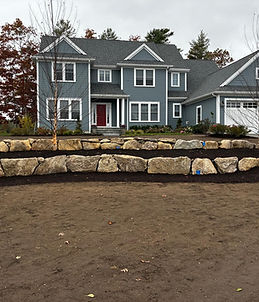
Slope correction reduces steepness to a manageable grade. We regrade to flatten slopes where site conditions allow, which slows runoff velocity and reduces erosion. On slopes too steep to regrade, retaining walls create level terraces that stop soil movement and create usable flat areas. Properties on hillier streets in Acushnet Center and near Howland Mill in New Bedford deal with slopes that have been slowly failing for years. Each nor'easter strips a little more until the topsoil is gone and the subgrade is exposed.
Runoff that crosses a property line and deposits soil in a neighbor's yard or into a storm drain can create liability. We look at what is upslope sending water onto the problem area and what is downslope receiving it before finalizing any grading plan. The fix has to work for the whole drainage path, not just the visible problem area.
Under Fairhaven Code Chapter 194 and Mattapoisett Chapter 172, property owners are responsible for managing stormwater runoff to prevent erosion and sedimentation that impacts neighboring properties and municipal systems.
Swales are a low-maintenance drainage solution for managing runoff across a property. A swale is a shallow graded channel that directs water across the surface toward a street, drainage area, or low point without installing any pipe. A properly graded swale handles significant stormwater volume and requires no maintenance.
Many properties in Fairhaven and across the South Coast can manage runoff entirely with correct grading and swales before any underground drainage infrastructure is needed. Fairhaven's stormwater standards require runoff velocities between two and 10 feet per second to prevent erosion damage. Erosion control on slopes that cannot be regraded includes deep-rooted groundcover plantings, erosion control fabric, and hydroseeding with tackifiers.
These approaches stabilize the soil surface while plant roots establish. The right solution depends on slope angle, soil type, and how the area will be used after stabilization. The Conservation Commission will enforce compliance with state wetland law and local bylaws if erosion control is inadequate. Any work within 100 feet of a wetland resource area requires Conservation Commission approval under Massachusetts Wetlands Protection Act (M.G.L. c. 131, s.40) and local town bylaws.
Standing Water and Soggy Lawns
Standing water that stays in the yard for days after rain is a grading problem in most cases. Low spots collect it. Grade that pitches toward the problem area keeps sending more. The lawn in those areas stays saturated long enough to kill grass roots, which is why wet areas almost always have patchy, thin, or bare grass.
Fixing standing water starts with understanding why it is there. If the grade sends water to that location, the grade needs to be corrected. If the area is genuinely low with no natural outlet, the fix involves either regrading to create a path for water to exit or installing drainage infrastructure to move it underground.
Muddy lawns after every rain tell you that surface drainage is not working. Water is sitting in the top layer of soil rather than moving across it or draining through it. Soil compaction makes this worse by reducing the rate at which water infiltrates. Core aeration opens up compacted soil and improves water infiltration, which helps on lawns where compaction is contributing to the drainage problem alongside grade issues.
Bare spots in low areas are one of the clearest signs that drainage is the real problem. Reseeding those areas without fixing the drainage is a temporary fix. The seed germinates, the grass grows in, and the next wet spring kills it again.
Correcting the grade or the drainage eliminates the standing water and lets grass establish permanently.

Best Time to Regrade a Yard
Early spring is the best window for regrading in Fairhaven and across the South Coast. The ground has thawed, frost heave has finished moving soil, and the spring rain season has not fully started yet. Getting grade corrections done in March or April means drainage problems get fixed before the heaviest rain months arrive and before the lawn is too far into active growth to work around.
Late fall is the second best window. Once the lawn has gone dormant and the leaves are down, the yard is easier to assess and work in without damaging an active growing lawn. Projects completed in October and November can be loamed and seeded before winter or left ready for spring seeding depending on the scope.
Summer regrading is possible but harder on established lawns. Heat and active growth make sod reinstallation and seeding more difficult. Properties where grade correction cannot wait until spring or fall can still be regraded in summer with the right approach, but timing the project before a stretch of moderate weather helps significantly.
The one time not to regrade is immediately after a wet stretch when the soil is saturated. Equipment on wet ground causes compaction and rutting that creates more problems than it solves.
Checking Elevations with a Transit Level and Grade Stakes
'
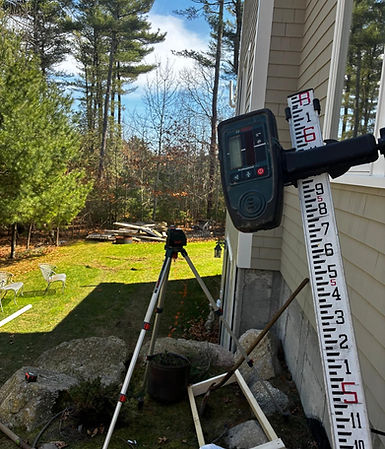
Before any grading work starts, we establish existing elevations across the property using a transit level and grade stakes.
A transit level is an optical instrument that reads elevations at multiple points across the yard from a fixed position. It gives us precise measurements of where the ground currently sits relative to the foundation, driveway, street, and surrounding features.
This is how we identify exactly where the grade is wrong and by how much.
Grade stakes go in at measured intervals across the work area after we have the elevation readings. Each stake is marked at the target finish grade for that location. During rough grading, equipment operators reference the stakes to hit the correct elevations as soil gets moved. Stakes get checked throughout the job as grades are established and adjusted.
Skipping this step is one of the main reasons grading work gets done incorrectly. Estimating grade by eye on a residential property is not accurate enough.
A yard can look flat and still pitch toward the foundation. A slope can look steep and still be within the correct range for drainage. The transit level removes the guesswork and gives us numbers to work from before the first machine moves.
Properties along Huttleston Avenue and in the older neighborhoods around Oxford Village in North Fairhaven frequently have established grades that have shifted significantly over decades.
Trees that have since been removed, old retaining features that have settled, and frost heave accumulating over many winters all change the original grade over time.
A transit survey tells us what is actually there now, not what the property was graded to originally.

Grading Around Hardscaping
Every hardscaping installation depends on the grading around it. Patios, walkways, retaining walls, seating walls, granite steps, and fire pits all need the surrounding ground graded correctly or they develop drainage problems, settle unevenly, and fail ahead of schedule.
Patios need a slope of 1 to 2 percent pitched away from the house so water sheds off the surface. That pitch has to be established at the subgrade level and maintained through every layer of base material.
Retaining walls need proper drainage behind them to prevent hydrostatic pressure from building up against the wall face. We grade drainage zones behind every retaining wall and install gravel backfill so water moves down and away rather than pushing against it.
Walkways and granite steps need grading that sheds water to the sides rather than letting it sit on the surface and freeze through New England winters.
Sod prep grading starts with establishing proper drainage slopes, spreading quality loam to the correct depth, and finish grading to a smooth, debris-free surface.
The finished grade sits approximately one inch below surrounding driveways and walkways to account for sod thickness.
Properties in Sconticut Neck, East Fairhaven, and near Fort Phoenix often have significant grade changes between the street and the rear of the lot.
Getting the surrounding grade right on those properties is what makes every installation on them last.
Getting Started With Yard Grading and Lawn Leveling
Properties throughout Fairhaven, Rochester, Acushnet, Mattapoisett, Marion, New Bedford, and Dartmouth need Yard grading and Lawn leveling that create a proper foundation for healthy landscapes.
Landscape grading prevents water problems and creates functional outdoor spaces with soil that actually supports plant growth.
Call 508-763-8000 or email request@newenglandtreeandlandscape.com. We'll schedule a site visit, assess the grading and soil conditions, and provide solutions to your drainage problems.
35 years in business. Local crew based at 232 Huttleston Avenue in Fairhaven. Family-owned. We're the caring professionals serving the South Coast.
FAQ's
What is the difference between yard grading and lawn leveling?
Yard grading changes the overall slope of the land so water flows in the correct direction. It often involves moving large amounts of soil with equipment to fix drainage or foundation problems. Lawn leveling is a surface correction that smooths small bumps and dips using sand or soil. Leveling improves mowing and appearance but does not significantly change drainage patterns.
Do I need regrading or a French drain for water pooling near my house?
If the yard slopes toward the house, the first step is usually regrading to push water away from the foundation. A French drain is more useful when water collects underground or the soil stays saturated. Many properties end up needing both: grading to control surface water and a drain to carry excess water away. The correct solution depends on the slope and soil conditions.
Can bad grading cause basement moisture or water around the foundation?
Yes, poor grading is one of the most common causes of basement moisture. When soil slopes toward the house, rainwater collects against the foundation instead of flowing away. Over time that water can seep through cracks or porous concrete. Correct grading reduces this pressure by directing water away from the structure.
How much slope should the ground have away from my foundation?
A common guideline is about 6 inches of drop over the first 10 feet away from the house. This slope is enough to move water away without making the yard noticeably steep. If the property cannot achieve that slope, drainage systems may be required. The goal is simple: water should never flow toward the foundation.
Why does my yard stay soggy for days after it rains?
Yards stay soggy when water cannot drain or soak into the soil efficiently. Flat grading, compacted soil, or clay-heavy ground can trap water near the surface. Poor drainage outlets or downspouts dumping water into the yard can also contribute. Without proper slope or drainage, water can sit for days after rain.
Can lawn leveling fix drainage problems, or do I need full regrading?
Lawn leveling can fix minor dips that hold small puddles. It works by filling low spots so water spreads more evenly across the surface. However, it will not fix a yard that slopes the wrong direction or stays saturated. Larger drainage issues usually require full regrading or installed drainage systems.
What affects the cost of yard grading and lawn leveling?
The biggest factor is the size of the area being corrected. Costs also increase when large amounts of soil must be moved or when equipment access is difficult. Drainage systems, soil type, and existing landscaping can also affect price. Simple leveling is usually far cheaper than full regrading projects.
Do I need a permit or Conservation review for grading work in Fairhaven, MA?
Small grading or lawn leveling projects typically do not require permits. However, work near wetlands, coastal areas, or protected land may require review from the local Conservation Commission. Larger projects that significantly change drainage patterns can also trigger oversight. It is always best to confirm requirements with the town before starting work.
Will regrading wreck my lawn, patio, or existing landscaping?
Regrading can disturb parts of the lawn because soil must be moved to reshape the slope. However, experienced contractors plan the work to minimize damage to patios, walkways, and plantings. In many cases the lawn is repaired or reseeded after grading is complete. The goal is fixing the drainage while restoring the landscape afterward.
My yard slopes toward the house. Where do I even start?
Start by identifying how water currently flows across the property. If rainwater moves toward the foundation, the soil around the house likely needs to be regraded. Downspouts should also direct water away from the house. Fixing the slope near the foundation is usually the first step.
Can I just add dirt around the foundation, or do I need to lower the yard too?
Sometimes adding soil near the foundation can create the correct slope away from the house. However, if the rest of the yard sits higher than the foundation area, the entire grade may need adjustment. Simply piling soil against the house can create other problems if drainage is not planned properly. The slope must continue outward, so water has somewhere to go.
How do you level a sloping yard?
Leveling a sloping yard starts with measuring elevations to understand how water currently moves across the property. From there, the solution may involve regrading, adding or removing soil, and in steeper areas, installing retaining walls to create stable, usable levels. The goal is not just to make it flat, but to control drainage so water moves away from structures and does not create new problems.