When to prune trees in Fairhaven, MA (season guide)
Updated: Mar 3
by Jorge Melo
Most trees on South Coast Massachusetts properties get pruned at the wrong time, if they get pruned at all. Bad timing leads to lost blooms, slow healing, and unnecessary stress that weakens trees heading into the nor'easter season. So, when should you actually prune trees in Massachusetts?
Late winter through early spring is the best window for most species. Trees are dormant, wounds seal faster once spring growth kicks in, and the bare canopy gives you a clear view of every branch.
Here in Fairhaven, we deal with coastal humidity, salt exposure, and freeze-thaw cycles that inland towns don't see. These conditions affect how trees respond to pruning and when they're safest to cut.
Below is a season-by-season breakdown plus species-specific guidance for properties across Fairhaven, Mattapoisett, Rochester, and Acushnet.

When to prune trees in Massachusetts by season
Winter pruning (best overall season in MA)
Winter is the safest, most effective time to prune the majority of trees in Massachusetts.
Between December and March, trees are fully dormant. Growth has stopped, sap flow is minimal, and most insects and fungal diseases are inactive.
Pruning during dormancy puts the least stress on the tree and gives the cuts time to begin sealing before spring pests emerge.
Without leaves blocking the view, our crew can see the full branch structure and identify deadwood, weak attachments, and crossing limbs that would be invisible in summer. This is especially useful on older properties throughout North Fairhaven and the Oxford School area, where mature oaks and maples have developed dense, complex canopies over decades.
Winter pruning also helps prepare trees for storms. Removing dead or weakened limbs before the nor'easter season reduces the chance of branches coming down on roofs, vehicles, and power lines.
Spring pruning (good, but timing matters)
Spring works well for specific situations, but heavy pruning during this season can cause problems. Sap flow is high, wounds bleed more freely, and trees are putting all their energy into new leaf and flower production. Cutting aggressively right now diverts resources away from growth.
Spring pruning does make sense for spring-flowering trees and shrubs.
Lilacs, forsythia, rhododendrons, and flowering cherry trees bloom on last year's wood, meaning they set their flower buds the previous summer. If you prune these plants in winter, you cut off next spring's flowers. Instead, prune them right after they finish blooming in late spring or early summer.
Spring is also a reasonable window for light corrective work: removing a storm-damaged limb, cleaning up a broken branch, or doing minor shaping on young trees.
Homeowners in Mattapoisett and the surrounding area often call us in April after winter storms leave behind cracked branches and split limbs. Cleaning this damage up quickly helps the tree heal before summer heat and humidity increase disease pressure.
Summer pruning (useful, but limited)
Summer is not the ideal time for major structural pruning, but it has practical uses. With leaves fully out, you can see the complete shape of the canopy and identify dead branches that weren't visible in winter.
You can also spot problem areas where foliage is too dense, blocking airflow and creating conditions for fungal disease.
Light summer pruning works well for raising canopies (removing low-hanging branches to clear walkways and driveways), thinning dense growth to improve air circulation, and removing deadwood.
Properties along Sconticut Neck in Fairhaven benefit from summer thinning because the coastal humidity promotes fungal growth in tight canopies.
The biggest risk with summer pruning is disease. Insects and pathogens are most active during warm months, and fresh cuts act as entry points. Keep summer work minimal and avoid pruning oaks entirely during this period.
Fall pruning (usually not recommended)
Fall is generally the worst time to prune trees in Massachusetts. When you prune, you stimulate new growth. Growth that starts in the fall won't have time to harden off before freezing temperatures arrive, which means those tender new shoots will die back over winter. The tree wastes energy producing growth that can't survive.
Fall wounds also heal slowly. The combination of cooling temperatures, wet conditions, and active fungi creates a setup for decay to enter pruning cuts. Our recommendation: skip heavy pruning in the fall entirely.
The one exception is removing dead, damaged, or hazardous branches. If a limb is cracked, diseased, or hanging dangerously, don't wait. Safety hazards get addressed regardless of the season.
Tree-specific pruning guidelines for Fairhaven homeowners
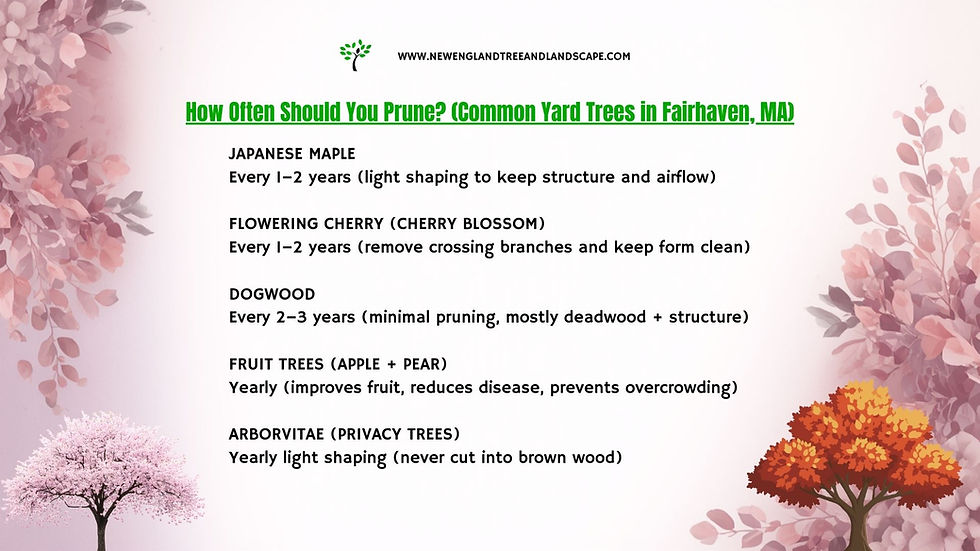
Spring-flowering trees (prune after blooming)
Spring-flowering trees and shrubs set their buds on old wood during the summer before they bloom. Pruning in winter or early spring removes those buds and eliminates the flowers for the entire season.
Common spring-flowering plants in Fairhaven and Mattapoisett landscapes include lilac, forsythia, rhododendron, azalea, dogwood, and flowering cherry.
The rule is simple: wait until the flowers drop, then prune within a few weeks. This gives the plant the rest of the growing season to develop new buds for next year.
Dogwoods and flowering cherry trees are especially popular in South Coast Massachusetts yards, and both follow this post-bloom schedule. These ornamental trees rarely need heavy pruning.
Focus on removing dead or crossing branches after the flowers finish, and leave the natural form alone. Over-pruning a dogwood or cherry removes the graceful branching habit that makes them worth planting in the first place.
Japanese maples (handle with care)
Japanese maples are one of the most common ornamental trees in Fairhaven and Mattapoisett landscapes. The best window for structural pruning is late winter, roughly mid-January through early March, while the tree is fully dormant and the bare branches let you see the layered form clearly.
Light thinning and fine shaping can also be done in late spring after leaves have fully emerged and hardened.
Summer works for removing deadwood or thinning dense interior growth, but avoid pruning on hot, sunny days since exposed inner branches can scorch.
The most common mistake with Japanese maples is removing too much at once. Never take more than 20% of the canopy in a single year. Focus on dead branches, crossing limbs, and inward-growing wood first.
The goal is to reveal the natural layered branching pattern, not reshape the tree into something it isn't. If major work is needed, spread it across two or three seasons.
Evergreens and arborvitae (minimal pruning, specific timing)
Arborvitae, juniper, boxwood, yew, and other evergreens planted as hedges, screens, and foundation plants across Acushnet and Rochester need far less pruning than deciduous trees.
Most only require light shaping to maintain form and manage size.
The best time to shape evergreens is late spring to early summer, after the new growth has pushed out and started to harden. Avoid late fall pruning, since new growth stimulated by cuts won't harden before winter.
One thing to know about arborvitae and most conifers: they don't regenerate from old wood. If you cut back into bare, brown interior branches, that section stays bare.
Regular light shaping is always better than waiting years and trying to cut an overgrown hedge back to size. If an arborvitae screen has gotten out of control, replacement is sometimes the better option.
Fruit trees (prune in late winter for better harvests)
Apple, pear, peach, and plum trees are common backyard plantings across Fairhaven, Mattapoisett, and Rochester.
Fruit trees need more deliberate pruning than ornamentals because the goal isn't just appearance, it's production.
Late winter is the best time to prune fruit trees in Massachusetts, typically February through early March, before bud's swell.
Dormant pruning promotes stronger fruiting wood, improves sunlight penetration into the interior, and reduces disease pressure from fungal problems like apple scab and brown rot.
The University of Massachusetts Extension recommends winter pruning specifically for better yields the following season.
The basic approach for most backyard fruit trees is to maintain an open center or modified central leader shape.
Remove water sprouts (the vigorous vertical shoots growing straight up from branches), thin crossing and inward-growing limbs, and take out dead or diseased wood.
Neglecting annual pruning pushes fruiting wood higher and farther from the trunk each year until the tree is producing only at the tips.
Don't prune fruit trees in the fall after harvest. It feels like the logical time, but fall pruning stimulates tender growth heading into winter and creates wounds that heal slowly in cold, wet conditions.
Shade trees, ornamentals, and storm prep
Larger trees like oaks, maples, and beeches need structural pruning every three to five years.
Smaller planted trees like crabapples, ornamental pears, and specimen trees in designed beds also benefit from regular attention on a similar schedule. These trees develop crossing branches, dense interiors, and deadwood just like their bigger counterparts.
Structural pruning includes removing dead branches, reducing weight on overextended limbs, thinning the crown for better wind resistance, and clearing branches away from roofs, gutters, and power lines.
Properties in East Fairhaven and along the coastline face strong winds from nor'easters and the occasional tropical system, making storm preparation through proper tree care a real priority.
We prune most shade and ornamental trees in winter through our tree and shrub care services. Dormant-season work causes the least stress and gives the best view of branch structure on complex canopies of any size.
Signs a tree needs pruning right now (safety + damage)
Some situations can't wait for the right season. If you notice any of the following on trees around your Fairhaven, Acushnet, or Rochester property, address them immediately:
Dead branches hanging overhead, especially above walkways, driveways, play areas, or parking spots
Cracked or partially broken limbs are still attached to the tree
Branches resting on your roof, pressing against siding, or tangled in power lines
Storm damage with torn bark, split trunks, or hanging debris
Signs of active disease spreading from one branch to others (discolored bark, oozing, mushrooms growing from wood)
Heavy leaning after a storm when the tree was previously upright
Dead and hazardous branches should be removed whenever they're found, no matter the time of year. Leaving a cracked limb in place through winter is an invitation for property damage or injury when the next storm hits.
Frequently asked questions about tree pruning
Can you prune trees in October in Massachusetts?
October pruning is risky in Massachusetts because trees are preparing for dormancy and fresh cuts heal slowly as temperatures drop. Fall moisture and mild temperatures also create favorable conditions for fungal infections. Stick to removing dead or hazardous branches only. Save structural pruning and shaping for December through March when the tree is fully dormant.
Is September too late to prune trees?
September is still part of the active growing season, but pruning stimulates new growth that won't have time to harden before frost. For most trees, it's better to wait until winter dormancy. The exception is spring-flowering shrubs like lilac and forsythia -- if you missed the post-bloom window, September is too late anyway. Wait until after they bloom again next year.
What are the "3 C's" of tree pruning?
The 3 C's stand for crossing, crowded, and compromised branches.
Crossing branches rub against each other and damage bark, creating entry points for disease.
Crowded branches restrict airflow through the canopy.
Compromised branches are dead, cracked, diseased, or structurally weak. Removing these three categories during regular pruning keeps trees healthier and reduces storm risk.
What happens if a tree is never pruned?
Trees that are never pruned develop deadwood that harbors disease, dense canopies that restrict airflow, and weak branch attachments that fail in storms. On Fairhaven and Mattapoisett Center properties, unpruned trees also grow into roofs, siding, power lines, and gutters.
What are the most common tree trimming mistakes homeowners make?
Topping is the biggest mistake -- cutting the main leader flat destroys the tree's natural form and creates weak, hazardous regrowth. Other common errors include flush cuts that remove the branch collar, pruning at the wrong time of year, removing too much of the canopy at once (never take more than 20-25% in a single session), and using dull or dirty tools that spread disease between plants.
Is it safe to prune a tree in summer, or can it damage the tree?
Summer pruning is safe for light work: removing deadwood, raising the canopy, and minor shaping. Avoid heavy structural pruning in summer because insects and fungal diseases are most active and enter through fresh wounds. For tree and shrub care services in Fairhaven, MA, we limit summer work to maintenance pruning and save major cuts for the dormant season.
When should you prune a Japanese maple, and what's the right way to do it?
Late winter (mid-January through early March in Massachusetts) is the best time for structural pruning on Japanese maples. The tree is fully dormant, sap bleeding is minimal, and the bare branches let you see the form clearly. Light thinning and fine shaping can also be done in late spring after leaves emerge. Never remove more than 20% of the canopy in a single year. Focus on dead branches, crossing limbs, and inward growth first.
Can a neighbor legally cut branches that hang over their yard in Massachusetts?
Yes. Under Massachusetts common law, a property owner has the right to trim branches and roots that extend onto their property, up to the property line. You don't need your neighbor's permission. However, you cannot trespass onto their property to do the work, and if your trimming kills or seriously damages the tree, you could be held liable.
Massachusetts General Laws chapter 242, section 7 allows triple damages for willful destruction of another person's trees, so proceed carefully.
Does New England Tree & Landscape handle tree pruning?
We provide tree and shrub care services in Mattapoisett, MA, Fairhaven, Acushnet, Rochester, and surrounding South Coast towns. Our crew handles pruning, trimming, disease treatment, and overgrown plant management as part of our full-service tree and shrub care program.
We do not do large-scale tree removals that require climbing or rigging; that work goes to specialized tree services.
What areas does New England Tree & Landscape serve?
We're based at 232 Huttleston Avenue in Fairhaven and serve all of Bristol and Plymouth County, including Fairhaven, Mattapoisett, Acushnet, Rochester, Marion, New Bedford, and Dartmouth.
Whether you need tree and shrub pruning in North Fairhaven or landscaping services in Mattapoisett, MA, our crew works across the entire South Coast region.
Need tree pruning or shrub care on your South Coast Massachusetts property?
Call New England Tree & Landscape at 508-763-8000 or email request@newenglandtreeandlandscape.com to schedule a walk-through and estimate.
We'll evaluate your trees, recommend the right timing, and handle the work professionally so your plants stay healthy and your property stays safe.
Sources
Johnston, Kevin. "The Best Time to Prune Your Trees This Year in Southeast MA." Regal Tree & Shrub Experts, 2025, regaltree.net/best-time-to-prune-southeast-ma/.
"Tree Pruning in Western Massachusetts: When, Why, and How Often?" Northern Tree Service, 24 Nov. 2025, northerntree.com/tree-pruning/tree-pruning-western-massachusetts/.
"The Right Time to Prune Your Trees in Eastern Massachusetts." Tree Tech Inc., 2025, treetechinc.net/tree-pruning/best-time-to-prune-trees/.
"When to Prune Trees & Shrubs." American Climbers, 22 May 2024, americanclimbers.com/when-to-prune/.
"Seasonal Guide: When to Book Tree Trimming in Central MA." Worcester Tree Trim & Removal, 3 Sept. 2025, worcestertreetrimremove.com/2025/09/03/seasonal-guide-when-to-book-tree-trimming-in-central-ma/.
"Massachusetts Law About Neighbors and Trees." Mass.gov, www.mass.gov/info-details/massachusetts-law-about-neighbors-and-trees.
Nislick, Robert. "Frequently Asked Questions About Tree Law in Massachusetts." Robert Nislick, Attorney at Law, 9 Sept. 2015, nislick.com/2015/09/09/frequently-asked-questions-about-tree-law-in-massachusetts/.
"Learn to Prune Japanese Maples." Fine Gardening, 1 Feb. 2025, www.finegardening.com/project-guides/pruning/pruning-japanese-maples.


Comments