
When does your yard need grading? Fairhaven, MA Guide
Updated: Apr 1
By Jorge Melo | New England Tree & Landscape
Water pooling against your foundation after every storm is not just annoying, it is actively damaging your home. If you are seeing puddles that linger for days, soil washing away from beds, or a damp basement after heavy rain, your yard likely needs grading.
Landscape grading is the process of reshaping soil, so water flows away from your home instead of toward it. Your yard should slope roughly two to five percent away from the foundation, about a two to six inch drop over ten feet.
When that slope is wrong or missing, water has nowhere to go. Homeowners across Fairhaven, New Bedford, and Acushnet deal with this constantly because of the region's heavy clay soils and coastal storm patterns. The good news is that grading fixes it for good.
Understanding landscape grading
Grading means adjusting soil elevations across your property to create intentional slopes that direct runoff.
The goal is controlled water movement, not just a flat or smooth-looking surface.
Every rain event sends water somewhere. Good grading sends it toward a drainage swale, the street, or a drainage system. Bad grading sends it straight into your basement.
Loaming goes hand in hand with grading. When soil is reshaped, the subgrade is usually poor-quality fill or compacted clay. Screened loam is then spread on top, four to six inches deep for lawn areas and eight to twelve inches for planting beds, to give roots a healthy growing zone.
Our yard grading and loam spreading services cover both steps so the finished surface drains correctly and supports healthy growth long term.
Properties in East Fairhaven, Sconicut Neck Rd, and the Acushnet Heights area of New Bedford tend to have heavy, slow-draining soils. A slope that would drain fine in sandy soil can still pool water here because clay holds moisture so effectively.
Warning signs your yard may need regrading
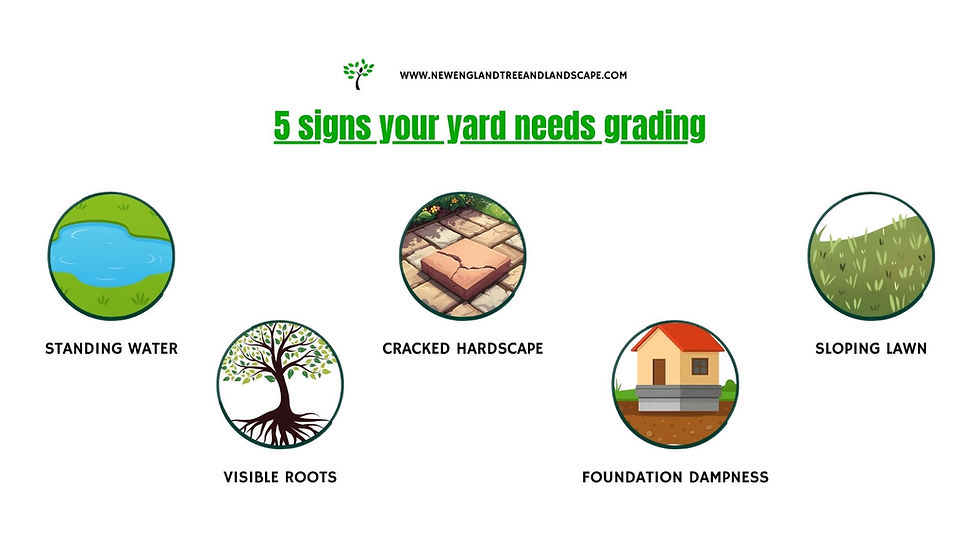
Standing water after rainfall
Puddles that disappear within a few hours are normal. Puddles that sit for a day or more are a grading problem. In the North End and South End of New Bedford, where lots tend to be flat and compact, this is one of the most common complaints we hear. Standing water kills grass roots, invites mosquitoes, and softens soil to the point where foot traffic causes ruts.
Soil erosion or visible root exposure
If tree roots that were underground a few years ago are now visible, soil is washing away. Bare patches in planting beds after storms, gullies forming along fence lines, and silt trails across the driveway are all signs water is moving too fast and taking soil with it. This shows up often on sloped properties in Acushnet Center and along hillier streets near Howland Mill in New Bedford.
An uneven or sloping lawn surface
Humps, depressions, and random low spots make mowing difficult and collect water. In older neighborhoods across Fairhaven and North Fairhaven, years of frost heave, tree removal, and settling trenches from utility work create this unevenness over time. A yard that was graded properly twenty years ago may need attention today.
Water draining toward the home's foundation
This is the most serious sign. If the ground around your house slopes toward the foundation rather than away from it, every rain event pushes water against your walls and into the soil at your footings.
Damp basements, efflorescence on foundation walls, and mildew on lower siding are all effects of negative grade. Correcting this is not optional if you want to protect the home long term.
Drainage issues around patios, walkways, or driveways
Hardscaping in Mattapoisett Center that holds water, heaves from frost, or develops edge cracks often has a grading problem underneath. Patios need a slight pitch away from the house so water sheds off the surface.
When the subbase is not graded properly before installation, water gets trapped, and winter freeze-thaw cycles cause real damage. If you are planning new hardscaping, our hardscaping team evaluates grade before a single paver goes down.
Why proper grading matters for your property
Protecting the foundation and basement
Foundation repair is one of the most expensive problems a homeowner can face. Water pressure against foundation walls over the years causes cracks, leaks, and structural movement. Proper grading is the first and cheapest line of defense. It keeps water out by preventing it from pooling at the walls in the first place.
Preventing long-term drainage problems
Grading problems get worse over time as soil settles and water continues cutting its own channels. Our erosion and control services address the full picture: slope correction, French drains, catch basins, and erosion control that holds soil while vegetation establishes.
If your yard floods after every nor'easter, grading likely needs to be paired with a drainage solution.
Our post on installing a French drain in Fairhaven, MA explains when that step becomes necessary.
Preparing the ground for landscaping or lawn installation
Grading should always come first. Seeding, sodding, or installing landscape beds over improperly graded ground sets everything up to fail. Grass will not establish over soil that holds water at the surface.
Our lawn care services and landscape design plans always start with a grade evaluation to make sure the site is ready.
Best time of year to regrade a yard in Massachusetts
Late spring through early fall is the ideal window for yard grading in southeastern Massachusetts. Soil needs to be workable, not frozen or saturated, so equipment moves without excessive rutting.
Late spring lets you address drainage issues from winter before summer heat makes turf establishment harder.
Summer is the most predictable window for earthwork.
Early fall works too, as long as seed or sod has time to root before the ground freezes.
Avoid early spring when soil is still waterlogged and avoid winter entirely.
Working saturated soil creates compaction problems and makes stable slopes hard to achieve.
How landscape grading projects are completed
Evaluating the property and measuring elevations
A proper grading project starts with a site assessment using laser levels to map existing elevations.
We look at where water runs during a storm, where it pools, how the grade falls from the foundation, and what is happening around hardscape edges and downspout discharge points.
Downspouts that dump water at the foundation can undo a properly graded yard on their own.
Correcting slopes and moving soil
Soil is moved using skid steers, excavators, or tractors, depending on site access and project size. Fill is brought in or redistributed to raise low areas and establish the correct fall away from the structure. Soil is compacted in lifts, so the grade does not settle back into problem spots after rain. On steeper areas or where space is tight, retaining walls or swales may be added to the plan.
Final grading and preparing the soil surface
Finish grading removes rocks, roots, and debris, and loosens the top layer so roots and seed can establish. Screened loam is spread to the proper depth and tied in cleanly with driveways, paver walkways, stone walkways, and existing landscape edges.
Landscape grading compared to excavation
Grading shapes surface elevations for water management. Excavation removes or relocates larger volumes of soil to create space for foundations, utilities, or retaining walls.
Most residential drainage projects involve both. Rough excavation establishes the major moves, and finish grading refines the surface, so everything drains correctly.
Situations where retaining walls become necessary
When a slope drops more than about one foot over three feet of horizontal distance, a retaining wall is worth considering. Walls also make sense when erosion is cutting into a bank near a driveway or foundation, or when you want level terraced areas for a paver patio or lawn.
Our landscape designer team integrates walls into grading plans, so drainage and site function work together.
See our post on the best ways to fix a sloped yard in Rochester, MA, for more detail.
Is it possible to regrade a yard yourself?
Overview of a basic DIY grading process
Small-scale regrading around a foundation is manageable for an experienced homeowner.
The basic process involves staking the area, running string lines to establish target elevations, moving soil to build up low areas or cut down high ones, compacting in thin layers, and finishing with loam and seed or sod. A string level, landscaping rake, wheelbarrow, and plate compactor are the core tools.
Common mistakes homeowners make when grading
Pitching soil toward the house instead of away from it
Burying siding or covering foundation vents with fill
Skipping compaction, which lets the grade settle back after the first heavy rain
Fixing one low spot while pushing water toward a neighbor's property or a stone patio
Not calling 811 before digging to locate underground utilities
When to hire a professional instead
Call a professional when water is entering your basement, when grades are steep enough to require heavy equipment, when the project involves drainage infrastructure like French drains or catch basins, or when permits may be required.
For most homeowners in Fairhaven, New Bedford, and Acushnet dealing with real drainage problems, professional layout and equipment are worth it.
Our post on how to level out your lawn helps you assess which situation you are in.
Typical cost of yard grading projects
Small DIY projects with hand tools and minimal soil: a few hundred dollars
DIY with equipment rental: roughly $500 to $1,000
Professional residential grading: commonly $1,000 to $5,000
Whole-yard regrading with drainage system integration: can run higher depending on scope
Labor typically runs around $50 per hour. Permits add $100 to $500 where required. Getting the grade right the first time is almost always cheaper than regrading after a landscape installation is already in, which means stripping sod, fixing grades, and reinstalling everything.
Yard grading services in southeastern Massachusetts
Yard grading services in New Bedford, MA
Properties throughout New Bedford, from the North End to the South End and the Howland Mill neighborhood, deal with older lot conditions, heavy clay soils, and irregular grades from decades of development.
Our yard grading services in New Bedford, MA, address drainage problems at the source. Whether water is entering a basement in Acushnet Heights or pooling in the backyard of a South End property, we assess the grade, plan the correction, and complete the work with the right equipment.
Yard grading services in Fairhaven, MA
New construction in North Fairhaven and East Fairhaven regularly leaves homeowners with inadequate grading. Lots that look finished at closing often slope toward the house or collect water after the first real storm.
We also handle regrading on established properties in Sconicut Neck where frost heave and tree roots have shifted grades over time.
Site grading in Acushnet, Marion, and Mattapoisett
We serve Acushnet and Acushnet Center as well as Marion, Mattapoisett, and surrounding Bristol and Plymouth County towns.
Site conditions vary across the region, and our crews know the soil types, seasonal drainage patterns, and permit requirements specific to each area.
What we evaluate during an on-site visit
We check slope direction at the foundation, downspout discharge locations, high and low spots across the property, existing hardscape elevations, overflow paths, and any signs of active erosion.
We also assess soil conditions and whether quality loam is present or needs to be brought in. That assessment drives the plan.
Frequently asked questions about yard grading
What are the most common signs that a yard needs grading?
Persistent puddles after rain, damp basements, soil eroding from beds or banks, grass that will not establish in wet areas, and ice sheets on walks or drives in winter are the most common indicators. If the ground next to your house slopes toward the foundation rather than away from it, that is the most urgent sign.
Should grading be done before installing a patio or deck?
Yes, always. Hardscaping installed on improperly graded subbase will heave, settle, and drain poorly. Our hardscaping services include a grading evaluation before any base material goes down.
How is soil stabilized after grading is completed in Fairhaven?
Soil is compacted in lifts after rough grading, then screened loam is spread as a finish layer. Seed or sod is installed to establish root coverage. On steeper slopes in Fairhaven and East Fairhaven, erosion control blankets protect the surface while vegetation takes hold.
What does it usually cost to have a yard regraded?
Most projects in the Fairhaven and New Bedford area fall between $1,000 and $5,000 depending on size, soil volume, and whether drainage components are involved. We provide free written estimates.
How long does a typical residential grading job take?
Most projects wrap up in one to three days. Larger lots or projects that include French drains or catch basins take longer. Site access and soil moisture also affect the timeline.
Can grading work damage nearby tree roots?
It can if the grade change is significant near the root zone. Adding several inches of fill over roots can suffocate them, and cutting grade near a tree can sever roots. A professional plan accounts for tree locations and routes changes to protect established trees.
Can uneven lawns create mowing or safety problems?
Yes. Humps and depressions cause mower decks to scalp high spots and miss low ones. Soft low spots cause wheels to sink and rut the turf. Uneven transitions near steps and driveways also create tripping hazards.
Is grading necessary if my yard slopes toward a neighbor's property?
If water drains onto a neighbor's lot and causes damage, that can create liability. In Acushnet and Acushnet Center where lots sit close together, it is worth addressing before it becomes a dispute.
How can I tell if downspouts are making my grading problem worse?
Check where your downspouts discharge. If they end at the foundation or dump into a low area, every storm adds concentrated flow to a spot with nowhere to drain. Downspout extensions and buried drain lines are often needed alongside regrading.
Does New England Tree & Landscape serve towns outside Fairhaven and New Bedford?
Yes. We serve communities throughout Bristol and Plymouth counties including Acushnet, Marion, Mattapoisett, Rochester, Dartmouth, and surrounding towns.
Get a free estimate for yard grading and drainage
Water problems do not wait, and neither should you. If your yard is showing any of the signs above, New England Tree & Landscape can assess the grade, find the cause, and fix it the right way. In our 35+ years of working on South Coast Massachusetts properties, we have seen every version of this problem and know what it takes to solve it for good.
Call us at 508-763-8000, email request@newenglandtreeandlandscape.com, or visit our loaming and grading services page to schedule your free estimate. We serve Fairhaven, New Bedford, Acushnet, and all of Bristol and Plymouth County.
What makes New England Tree & Landscape different from other grading contractors on the South Coast?
We are a family-owned company based out of 232 Huttleston Avenue in Fairhaven with 35+ years of experience working specifically on South Coast Massachusetts properties. We do not subcontract our grading work.
The same local crew that shows up for the assessment completes the job, and we back every project with a free written estimate, so you know exactly what is being done and why before any equipment arrives.
Does New England Tree & Landscape handle both the grading and the lawn or landscaping installation after?
Yes. We handle the full scope from rough grading and loam spreading through seed or sod installation, planting beds, and hardscaping. That matters because grading done in isolation, without someone thinking about what goes on top of it, often creates problems at the seams.
Our landscape design and lawn care teams coordinate directly with the grading crew, so the finished property drains correctly and looks right from day one.
Sources
Melo, Jorge. "Complete guide to landscape grading in Massachusetts." New England Tree & Landscape, 13 Oct. 2025, newenglandtreeandlandscape.com.
New England Tree & Landscape. "Yard grading & loam spreading services in Fairhaven, MA." newenglandtreeandlandscape.com.
Edwards Lawn & Landscaping. "Lawn rejuvenation: when and why your yard needs grading." 7 Mar. 2025, edwardslawnllc.com.
Castle Point Landscape Design. "What is the best time for yard regrading?" 18 Jun. 2025, castlepointlandscape.com.
Minasian-Koncewicz, Stephanie. "Yard grading: everything you need to know." This Old House, 11 Jun. 2025, thisoldhouse.com.
Westy's Property Services. "5 signs it's time to grade your yard." 2 May 2024, westyspropertyservices.com.
Ware Landscaping. "What is yard grading & how does it improve drainage?" warelandscaping.com.


Comments