

Stone Walkway Installation in Fairhaven, MA
A natural stone walkway changes how your property feels the second you step onto it. Instead of cutting across grass or walking a worn path to the front door, you have a defined entry that feels solid and built into the property.
Bluestone gives you large, flat slabs with tight joints and straight lines that fit the kind of front entries you see around Fairhaven Center and older homes. Granite brings a heavier, more permanent feel that ties into existing steps and foundations. Flagstone creates a more natural path with irregular shapes that blend into planting beds and yard space, so it looks like it belongs there instead of being forced into place.
Call 508-763-8000 or email request@newenglandtreeandlandscape.com for a free on-site estimate.
How We Design a Stone Walkway for Your Property
No two properties on the South Coast are laid out the same way, and no two stone walkways should be either. Before any material is selected or any base work begins, we come out and look at the site. We walk the path from the street to the door, assess the grade, identify where water moves after heavy rain, and take note of what the house looks like, what the yard looks like, and what the entry is actually missing.
Material selection follows from that conversation. Bluestone suits a formal front entry on a traditional colonial where clean lines and consistent joints fit the architecture. Granite is the call when durability is the priority and the entry sees heavy daily use year-round. Flagstone works when the property has mature plantings, a relaxed coastal character, and a setting that calls for something organic rather than geometric.
Width, pattern, and how the walkway connects to the driveway, steps, or patio all get worked out before excavation begins. Changes made on paper cost nothing. Changes made once the crew is on site cost significantly more. We use a transit level to verify grade across the full run before any base material goes down, so drainage is built in correctly from the first layer up rather than corrected at the surface after the fact.
The goal at the end of every project is a walkway that looks like it was always part of the property. Not something dropped in front of the house, but something that belongs there.

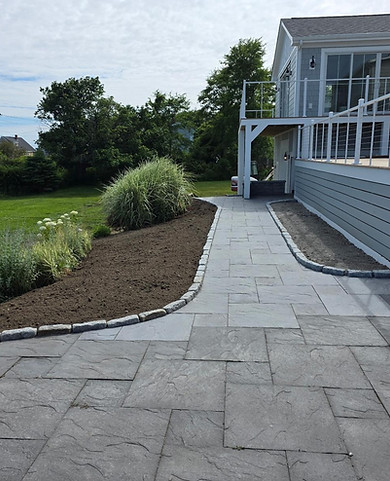
Bluestone Walkway Installation
Bluestone is the most common natural stone walkway material we install, and for good reason. It handles coastal salt air without the surface deterioration you see with softer stones, cuts into clean consistent shapes, and gives a front entry the kind of refined character that suits a wide range of home styles.
Properties along Sconticut Neck Road near Fort Phoenix deal with salt air year-round. Bluestone is one of the few natural stone options that holds up in that kind of exposure over the long run without significant degradation.
Bluestone comes in two finishes:
Natural cleft bluestone has the rough, textured surface that results when the stone is split along its natural grain. It provides solid traction when wet and gives the walkway an organic, handcrafted feel.
Thermal bluestone has been heat-treated to produce a smoother, more uniform surface with a slightly more contemporary appearance.
Both perform well in freeze-thaw climates. The choice comes down to the look of the home and how the walkway will be used day to day.
Joints in bluestone walkways are typically filled with polymeric sand. This material hardens when activated with water, resists washout during heavy rain, and discourages weed growth in the joints. It is standard on every bluestone walkway we install because it directly affects how the surface holds up through the first several seasons.
Granite Walkway Installation
Granite is the most durable natural stone available for walkway installation. It is one of the hardest materials used in residential hardscaping, highly resistant to surface wear, salt exposure, freeze-thaw stress, and heavy foot traffic. A granite walkway installed correctly on a proper base will outlast almost everything else you could put in its place.
For front entries that take a serious beating year after year, granite is the right answer. Properties with large families, pets, or high daily foot traffic benefit most from granite's resistance to the surface wear that softer stones develop over time.
Granite also has a visual weight and permanence that suits formal front entries particularly well. The gray and silver tones pair naturally with cedar shingle, clapboard, and brick exteriors common throughout coastal New England. When granite treads are paired with matching granite steps and a granite cap on an adjacent seating wall or stoop, the full entry reads as a cohesive, high-quality material story rather than components assembled separately.
Finish selection matters for safety on a walkway. Thermal and flamed finishes create a slightly textured surface that provides traction and holds up to wet conditions. Polished granite is not appropriate for outdoor walkway use because it becomes dangerously slippery when wet or icy. We only install granite in finishes appropriate for exterior foot traffic.
Sealing is another consideration. Granite is dense, but it can still absorb oils, dirt, and organic staining over time. Applying a breathable sealer helps reduce staining and makes the surface easier to clean without changing the natural look of the stone.


Flagstone Walkway Installation
Flagstone works when the setting calls for something that feels less formal and more connected to the landscape around it. The irregular shapes and natural surface texture give a path an organic character that fits naturally around planting beds, through garden areas, and on properties with mature established landscaping where a clean-edged geometric layout would cut awkwardly through the surroundings.
Unlike bluestone or granite, no two flagstone walkways look exactly alike. Each stone is positioned and sometimes cut so the pattern develops from the shapes of the individual pieces. The result is a path that reads as though it grew from the yard rather than being placed on top of it. That quality is part of the appeal of flagstone, and it is also what makes installation more labor intensive than cut stone.
Surface traction on flagstone varies depending on the specific stone and finish. Flagstone that is irregular in texture provides reasonable grip when dry. When wet, some flagstone surfaces can become slippery depending on how smooth the individual pieces are. For front entries where consistent safe footing matters in all weather, bluestone or granite with appropriate finishes are the more reliable choices. Flagstone is better suited to garden paths and secondary walkways where the setting calls for it visually and heavy daily use is not a primary concern.
Moss growth in flagstone joints is a common and expected occurrence on shaded walkways across the South Coast.
On properties where mature tree canopy keeps the surface cool and damp through the growing season, moss will establish in the joints.
Some homeowners prefer this and allow it to develop intentionally. Others prefer to keep the surface clear with an iron sulfate treatment or diluted solution applied annually. Either approach is manageable. What matters is choosing the approach that fits the setting and maintaining it consistently.
What to Expect During Stone Walkway Installation
Most natural stone walkway installations on a standard residential property in Fairhaven take between two and four days from first equipment on site to final cleanup. Projects involving significant grade changes, new steps, or drainage work along the path take longer. We give you a realistic timeline before work starts.
The first day is almost entirely base work. Existing material comes out, the area is excavated to the correct depth for the stone thickness and your soil conditions, and compacted crushed stone goes down in layers. This is the part of the job that determines how the walkway performs over the next two or three decades. It is also the part that disappears entirely once the stone is laid, which is why contractors who underbuild the base are difficult to identify until the surface starts moving a few winters later.
On most projects, stone setting begins on day two. Layout lines are established from the most visible point outward, pieces are positioned and cut to fit, edge restraints are set, and joint material goes in. Natural stone requires more hand positioning and fitting than manufactured pavers. Each piece is assessed individually before it is set, which is part of what makes stone installation more labor intensive and part of what produces a finished surface that looks genuinely handcrafted.
Your driveway access may be limited while equipment and material are staged on site. We coordinate timing with you before work starts. Existing plantings close to the work area are protected or temporarily relocated where needed. All excavated material is hauled off and the site is left clean at the end of the project.
How Stone Walkways Are Priced on the South Coast
Stone walkway pricing has more variables than most homeowners expect going in, and the number that comes back from a good contractor is rarely just the cost of the stone. What you are actually paying for is the full system: excavation, base preparation, drainage, the stone itself,, joint material, and any steps or grade transitions the project requires.
Material choice drives the baseline cost. Bluestone is the mid-range option for natural stone walkways on the South Coast and the most common choice for front entries. Flagstone runs in a similar material cost range but carries higher labor because every piece is hand-fit individually. Granite is the highest material cost of the three and the most labor intensive to set due to the weight and hardness of the stone.
Site conditions move the number from there. Existing walkway demolition and removal adds cost. Grade changes that require steps add cost. Drainage runs along the path add cost. Tight site access that limits equipment use adds cost.
A stone walkway costs more upfront than a paver walkway. Over the life of the project on the South Coast, where coastal conditions and hard winters punish lesser surfaces, natural stone installed correctly on a proper base is the more cost-effective choice for homeowners who intend to stay in the home and do not want to revisit the project in ten years.
Stone Walkway Repair
Settled stones, rocking sections, standing water after rain, and uneven joints that have opened up over time are all repairable conditions. None of them mean the walkway needs to come out entirely.
Repair starts with identifying what actually caused the problem. Surface symptoms almost always point to something happening in the base. A stone that rocks is sitting on a base that moved. A section with standing water is not draining correctly underneath. A walkway with multiple sections shifting in the same area usually has a drainage issue that is saturating the base through wet seasons rather than an isolated compaction problem.
We lift the affected stones, assess the base condition underneath, correct the cause of the failure, and reset the surface. Stone that is cracked or broken gets identified before work starts. We tell you what can go back down and what needs to be replaced. Most well-sourced natural stone survives the kind of base movement that causes surface displacement and can be reused after the base is corrected.
Drainage repairs are handled as part of the base correction, not as a separate step. Resetting stones over an unresolved drainage problem produces the same failure on the same timeline. We do not do repairs that are designed to need repeating.
Why Stone Walkways Outlast Poured Concrete in New England
Poured concrete fails in this region for a predictable reason. The freeze-thaw cycle. Water saturates the slab or works into existing cracks, freezes, expands, and forces the crack wider. The ground beneath shifts and the rigid slab cannot move with it. Within a few winters the surface is broken and there is no repair short of full replacement.
Salt air compounds the problem significantly. Properties near Fort Phoenix and along the Buzzards Bay shoreline deal with salt air exposure year-round. Salt attacks concrete through a deterioration process that breaks the surface layer apart from within over time. Concrete that was not poured with the correct density and air-entrainment specifications for coastal exposure fails faster than most homeowners expect.
Natural stone set dry-laid over a compacted base works differently. Individual stones are not bonded to each other or to a rigid slab. When the ground shifts through a freeze-thaw cycle, stones move with it without cracking. A section that settles can be lifted, the base corrected, and the stone reset. The surface stays intact and repairable through decades of New England winters in a way that poured concrete simply cannot match.

Stone Walkway Installation Across the South Coast
New England Tree & Landscape installs bluestone, granite, and flagstone walkways throughout the area and all surrounding South Coast communities. We have worked on everything from short formal front entries to longer garden paths running through established plantings, around grade changes, and connecting patios to driveways.
A large share of our stone walkway projects are part of larger hardscaping jobs that include a patio, retaining wall, or new front steps. When the full entry is planned together, materials match and drainage is handled across the whole property rather than one section at a time. We are a family-owned crew based in Fairhaven with over 35 years of hardscape work across the region.
Call 508-763-8000 or email request@newenglandtreeandlandscape.com for a free estimate.
FAQ's
Can a sunken or uneven stone walkway be repaired, or does it need to be replaced?
Most sunken and uneven stone walkways can be repaired by lifting the affected stones, correcting the base underneath, and resetting the surface. The stone itself rarely fails. We assess the full walkway during repair visits to determine whether the problem is isolated or spreading and tell you honestly what needs to come up versus what is still stable.
What is better for a front walkway: bluestone, granite, or flagstone?
Bluestone is the most common choice for front walkways on the South Coast because it cuts uniformly, creates clean consistent joints, and holds up well in salt air environments. Granite is more durable and suits high-traffic entries or properties that already have granite steps. Flagstone works better in garden settings and informal entries than as a primary front walkway because the irregular shapes and wider joints are harder to maintain and less forgiving underfoot in winter conditions.
Can I put a stone walkway right up to the public sidewalk in Fairhaven?
You can connect your walkway to the public sidewalk, but if the work touches or crosses the public right-of-way, the Fairhaven DPW requires a Non-Standard Pavement Agreement because natural stone is classified as non-standard material. The residential permit fee is $50. Standard approved materials for public sidewalks are asphalt, concrete, and stamped concrete.
Does a stone walkway need Conservation approval if my Fairhaven property is near wetlands?
Work within 100 feet of a wetland, within 200 feet of a perennial stream, or within coastal resource areas under the Massachusetts Wetlands Protection Act may require a Notice of Intent filed with the Fairhaven Conservation Commission. Properties near Nasketucket Bay, the Acushnet River, and Sconticut Neck are most likely to fall into these setbacks. We identify wetland proximity during the estimate.
Do I need a permit for a stone walkway in Fairhaven, MA?
Most ground-level stone walkways on private residential property in Fairhaven do not require a building permit. Projects that involve significant grading, retaining walls, or work near wetlands may require review by the Building Department or Conservation Commission. We identify permit requirements during the estimate process.
Does a stone walkway need Conservation approval if my Fairhaven property is near wetlands?
Work within 100 feet of a wetland, within 200 feet of a perennial stream, or within coastal resource areas under the Massachusetts Wetlands Protection Act may require a Notice of Intent filed with the Fairhaven Conservation Commission. Properties near Nasketucket Bay, the Acushnet River, and Sconticut Neck are most likely to fall into these setbacks. We identify wetland proximity during the estimate.
Do I need to replace the front steps when I replace the walkway?
Not always, but it is worth evaluating at the same time. If the existing steps are in good condition and the material can be matched or complemented by the new walkway, they can stay. If the steps are settling, cracked, or made of a material that will not read well against the new walkway, replacing them as part of the same project produces a more cohesive result and costs less than coming back to do them separately.
Do I need to call Dig Safe before installing a stone walkway?
Yes. Massachusetts law requires a Dig Safe call at least three business days before any excavation. We handle the Dig Safe notification for all projects we install so utilities are marked before base work begins.