
Can a Swale Prevent Flooding in Fairhaven, MA? Local Guide
by Jorge Melo
Fairhaven has about 29.4 miles of shoreline along Buzzards Bay, the Acushnet River, and New Bedford Harbor, which is why runoff and flooding are such active local issues (Fairhaven Open Space and Recreation Plan).
If your yard floods every time it rains and you are tired of standing water near the house, you already know this is not a small problem.
A swale can prevent flooding on the right Fairhaven property, but only when surface runoff is the real issue and the lot has room to slow, hold, and release the water safely.
Swales will not stop coastal storm surge, a high water table, or water pushing against a foundation from below grade.
Fairhaven gets about 42 to 45 inches of rain each year (Fairhaven Open Space and Recreation Plan). Drainage features have to handle repeated wet periods, not just one big storm.
Our team has helped homeowners across Fairhaven, North Fairhaven, East Fairhaven, and Sconticut Neck sort out which drainage fix matches their yard.
The wrong system wastes money and can send water into a neighbor's yard.
Can a swale stop yard flooding in Fairhaven?
Sometimes, yes. A swale is a shallow, gently sloped channel that catches surface water and slowly moves it to a safe release point. When flooding is caused by water running across the surface, a swale can be the right fix.
Massachusetts CZM describes vegetated swales as channels that intercept, treat, and slowly convey stormwater runoff to an area where it can soak into the ground (Massachusetts CZM, Vegetated Swales Fact Sheet).
A swale works for sheet flow, driveway runoff, and roof discharge spreading across the lawn. It does not fix wet soil, a seasonally high water table, or basement seepage.
In Fairhaven, those problems are common on lots with Woodbridge, Ridgebury, or Whitman soils, where water tables can sit close to the surface during wet periods (Fairhaven Open Space and Recreation Plan).
On low-lying roads like Sconticut Neck Road, flooding during major coastal storms is driven by tidal forces, not lawn runoff.
The short version: a swale helps when water moves. It struggles when water sits.
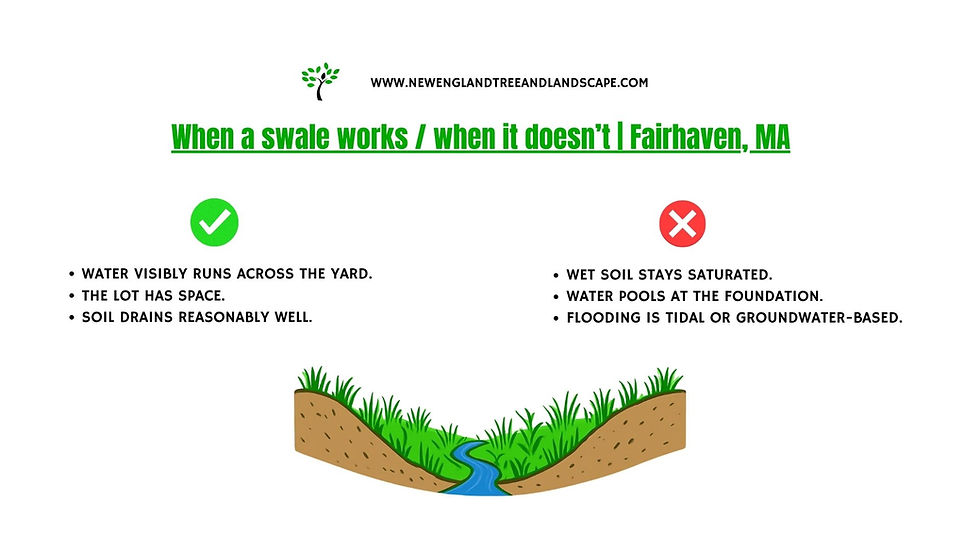
What a drainage swale does on a Fairhaven property
A drainage swale is a shallow low point in the yard, shaped with purpose. It is wider than it is deep. The sides are gentle. The bottom slopes just enough to move water. You can line it with grass, plants, or stone. Either way, it catches runoff and sends it somewhere safer.
We see this on many properties we service through our yard drainage solutions in Fairhaven, MA. Yards that used to puddle after every storm now move water along a clear path.
How a swale moves surface water away from low spots
Water always picks the lowest path. A swale gives water a planned low path to follow so it does not pool at random. The channel slows the flow. Plants or stone inside slow it more.
By the time water reaches the end of the swale, it is either soaking into the ground or leaving the property at a controlled speed.
Rain events above 1 inch are rare in Massachusetts and happen in less than 10 percent of storms, which is why properly sized swales handle most everyday rainfall (Massachusetts CZM, Vegetated Swales Fact Sheet).
Why a swale is different from a French drain or catch basin
A swale handles water on top of the ground.
A French drain handles water under the ground.
A catch basin collects water at a specific point and sends it into a pipe.
Different problems, different tools.
If the lawn is soggy because water is stuck in the soil, a French drain is usually the right call.
If a driveway puddle washes across the yard, a swale fits better.
Our guide to catch basin vs French drain walks through the trade-offs.
When a swale is the right drainage fix in Fairhaven
Swales shine in specific conditions. Over the years we have learned to look for three clear signs before we recommend one on a property in New Bedford, Fairhaven, or Acushnet.
Water is running across the surface of the yard
This is the strongest sign. You can watch the water move. It comes off a driveway, off a downspout, or off a neighbor's slope, and it washes a visible path across the lawn.
Maybe it leaves a muddy streak. Maybe it kills the grass along that line. If the problem is concentrated flow on top of the ground, a swale can catch it and route it.
Your lot has room for a gentle drainage path
Swales need space. The channel should be 2 to 10 feet wide at the base, with side slopes around 25 to 30 percent, and it should sit at least 10 feet from home foundations and 50 feet from septic systems (Massachusetts CZM, Vegetated Swales Fact Sheet).
Bigger lots in Acushnet Center or around Mattapoisett Neck often have the room. Tight lots in the North End of New Bedford or Howland Mill may not.
You need to move runoff without adding underground pipe
Some lots have no good place to tie into a drain. The soil drains too slowly for a dry well. The street is uphill. The lot line is close.
A swale keeps the whole system above ground, so it does not need a buried outlet pipe. That makes it a smart pick when underground options are limited.
When a swale will not fix the flooding problem
A swale is a tool, not magic. When the problem is not surface runoff, a swale will not solve it.
The yard stays wet because of a high water table
Some Fairhaven soils sit over hardpan or have seasonal water tables close to the surface (Fairhaven Open Space and Recreation Plan). Water is not flowing across the lawn. It is pushing up from below.
Massachusetts CZM notes that a swale needs at least 2 feet of dry soil between the base and the water table to work properly (Massachusetts CZM, Vegetated Swales Fact Sheet). If that depth is not there, the swale holds water instead of draining it.
Water keeps pooling near the foundation
Basement dampness during storms is usually caused by groundwater building hydrostatic pressure against the wall. A swale up in the yard does not relieve that pressure. A perimeter drain is the right tool.
Our erosion and drainage planning services often combine foundation drainage with surface grading, because most wet basements in Fairhaven are caused by two problems at once.
Coastal storm flooding needs more than a swale
Fairhaven's 2040 master plan says sections of Sconticut Neck Road and the West Island causeway are about 15 feet above mean sea level and have flooded during major coastal storms (Fairhaven 2040 Master Plan).
No homeowner-scale swale fixes tidal surge.
For coastal lots, the right conversation is about flood zone rules, site grading, and protecting the house itself.
Why some Fairhaven yards flood more than others
Two houses on the same street can have very different flooding problems. The reason is usually in the ground, not the sky.
Sandy soil, hardpan, and wet pockets change how water moves
Hinckley and Merrimac soils are sandy and drain fast, with water tables often deeper than 6 feet (Fairhaven Open Space and Recreation Plan).
A swale on those soils gets real infiltration benefit.
Woodbridge soils have hardpan 2 to 3 feet down and seasonal water tables around 1.5 to 4 feet in wet periods.
A swale still helps, but it acts more like a channel than an infiltration system.
Ridgebury and Whitman soils are toughest. Water tables can reach the surface. Those yards need a broader drainage plan.
Buzzards Bay weather and coastal conditions add drainage pressure
Coastal storms bring heavy rain on top of saturated ground. Wind blows leaves and debris into drainage paths. Salt spray changes what plants will grow. A swale on a coastal lot near Sconticut Neck Road has to deal with all of that at once. Salt-tolerant plants matter. So does regular sediment removal.
Flat grades and settling keep water trapped
Older Fairhaven neighborhoods were not always graded for drainage. Lawns settle. Shade trees keep ground soft. Low spots form.
In the South End of New Bedford and Acushnet Heights, we see plenty of lots where the yard is dead flat and water has nowhere to go.
On those properties, a swale has to be paired with light regrading to create any slope at all.
Our guide to when your yard needs grading covers the clearest signs.
Swale vs French drain vs regrading in Fairhaven
Here is how the main drainage fixes compare side by side.
Drainage fix | Best for | How it works | Weakness |
Swale | Surface runoff across the yard | Shallow channel slows and routes water above ground | Needs space and a safe outlet |
French drain | Water stuck in the soil | Perforated pipe in gravel pulls subsurface water out | Pipe can clog with silt or roots |
Regrading | Yard slopes toward the house or dips in the middle | Reshapes the ground so water runs the right direction | Does not move water off the property by itself |
Catch basin | One concentrated pooling spot | Grated box collects water at a point and feeds a pipe | Only helps where it is installed |
Your yard is a good candidate for a swale if:
You can see water running across the surface after a storm
The lot has room for a wide, gently sloped channel
Runoff comes from a driveway, downspout, or uphill neighbor
There is a safe place to release the water on your own property
The soil drains well or has a deep water table
Your yard is a poor candidate for a swale if:
The ground stays saturated days after the rain stops
Water is pooling right next to the foundation
The lot is tight with no room for a 2 to 10 foot wide channel
The only place to send water is a neighbor's yard or the road
The flooding comes from tidal surge or a coastal storm
When regrading is the better call, the signs are different. Water runs toward the house. The lawn dips in the middle. Only reshaping the ground fixes a grade problem.
Our yard grading service in Fairhaven handles lots where the soil needs to move before any drainage feature will work.
More in our guide to how to level out a lawn or our post on how to fix standing water on South Coast Massachusetts yards.
Where a swale works best around a Fairhaven home
Placement is everything. A swale in the wrong spot is just a wet ditch.
Side yards and rear yards
The strongest spots are side and rear yards where water is already moving. These give you length, which a swale needs.
On properties we service through our yard drainage installation in East Fairhaven, side-yard swales often catch runoff from neighboring slopes.
Lawn low spots and drainage paths
If the lawn already has a low spot where water gathers, the ground is telling you where it wants to go. A properly shaped swale takes that natural path and makes it work.
On flat ground in the South End of New Bedford, we sometimes pair a shallow swale with light regrading.
Driveway edges and property lines
Driveway runoff is one of the most common flooding sources in our area. Sealed asphalt absorbs nothing. Water shoots off the driveway and into the lawn.
A swale along the edge catches that runoff. Near Sconticut Neck, we have installed driveway-edge swales that moved water from a soggy lawn to a stable planted channel in one project.
Swale design basics that matter for flood prevention
A swale works when the math is right. When the math is off, it does not.
Size, slope, and depth
Massachusetts CZM recommends swales about 18 inches deep to hold 12 inches of water (Massachusetts CZM, Vegetated Swales Fact Sheet).
The base should be 2 to 10 feet wide, side slopes around 25 to 30 percent, and the slope along the length 1 to 3 percent. Too steep and water races through. Too flat and water does not move.
Plants, stone, and erosion control
Vegetated swales use moisture-loving native plants to slow water and hold soil. Grasses, sedges, and perennials work in the base.
Shrubs and deeper-rooted plants hold the sides.
Near the inlet, crushed stone diffuses the flow.
Grassed swales work too, but they need to be mowed and cannot be cut shorter than the expected water depth.
Overflow and maintenance
Every swale needs an overflow plan. Massachusetts CZM guidance says the swale should drain within 24 to 48 hours (Massachusetts CZM, Vegetated Swales Fact Sheet).
Inspect the inlet and outlet every few months. Clear leaves and sediment.
Add stone where you see erosion. A neglected swale fills in and stops working.
Fairhaven drainage rules, wetlands, and permits
Drainage work in Fairhaven is not always a private decision. Local and state rules can apply, especially near wetlands or the coast.
When Chapter 194 matters
Fairhaven's stormwater regulations, Chapter 194, set standards for how runoff is managed. The regulations state that drainage swales should be sized for the 25-year storm with velocities below 4 feet per second (Fairhaven Draft Stormwater Regulations).
Most single-family backyard swales do not trigger formal review, but the design standards are a useful benchmark.
When to check with the Conservation Commission
Work within 100 feet of a wetland, stream, or coastal resource area can require approval from the Fairhaven Conservation Commission.
Massachusetts CZM says projects near protected resource areas are likely to need a permit (Massachusetts CZM, Vegetated Swales Fact Sheet).
A quick call before digging saves headaches later.
When to bring in a drainage contractor
The trickiest part of swale work is not the digging. It is reading the site.
Soil, slope, outlet, and neighbor impact all have to line up.
In our 35+ years of business, we have seen DIY swales that created new flooding problems because the outlet sent water the wrong direction.
Frequently asked questions about swales and yard flooding
Do swales prevent flooding or just reduce it?
Swales can prevent the kind of flooding caused by surface runoff on a properly sized lot. For routine storms on a yard with the right soil and slope, a swale can stop the flooding you see now. For bigger storms, coastal flooding, or groundwater problems, a swale reduces the issue but does not erase it. In Fairhaven, rainfall over 1 inch happens in less than 10 percent of storms, so a well-built swale handles most real-world rain events.
Will a swale stop water from reaching my foundation?
A swale placed uphill of the house can intercept surface water before it reaches the foundation, which often solves basement puddling caused by runoff. It will not stop water pushing against the foundation from below.
For groundwater problems, a perimeter drain is the right fix.
We often pair a swale with a foundation drain during a single yard drainage installation in Fairhaven, MA.
Is a swale better than a French drain for surface runoff?
For true surface runoff, yes. A swale is cheaper to install, easier to maintain, and does not rely on a buried pipe that can clog. French drains are better when water is trapped in the soil. If you can see the water moving, a swale wins. If the ground is just soggy, a French drain wins.
Can a swale help on a Fairhaven property with a high water table?
Only partly. A swale can still move surface runoff to a safer spot, but it will not soak water into the ground the way it does on drier soils. On Ridgebury or Whitman soils, the swale acts as a controlled channel that carries water away. It does not dry out the lawn.
How long should water stay in a swale after rain?
Water should drain within 24 to 48 hours (Massachusetts CZM, Vegetated Swales Fact Sheet). If your swale holds water longer, the soil may not be draining, or sediment has built up and clogged the base.
Do I need a permit to build a swale in Fairhaven?
Most backyard swales on a regular residential lot do not need a permit. The rules tighten when your property is within 100 feet of a wetland, stream, pond, salt marsh, or coastal resource area, which can trigger Conservation Commission review. Check your lot on the MassGIS Oliver tool and the FEMA Flood Map Service Center before digging. If you see a wetland or flood zone line near your property, call the Fairhaven Conservation Commission to confirm what is needed.
What slope does a swale need to work correctly?
The length of the swale should slope 1 to 3 percent. Gentler than 1 percent and water sits. Steeper than 3 percent and water moves too fast, which causes erosion. If the yard is too flat, check dams can pond water in short sections so infiltration still happens.
When is regrading a better solution than a swale?
When the yard slopes the wrong way. A swale manages water. Regrading changes where water goes in the first place. If the ground tilts toward the house, regrading pulls the grade back. On many Fairhaven lots, the best answer is both.
More in our post on the best ways to fix a sloped yard.
What are the cons of a swale?
Swales take up real yard space and only work when the lot has room for a wide, gently sloped channel. They need a safe outlet, which can be a problem on tight lots or near property lines. Regular maintenance is part of the deal, meaning sediment removal, replacing washed-out stone, and managing plants.
How long does a swale last?
A well-built vegetated swale can last 20 years or more with regular upkeep. Plants get stronger over time, which actually improves performance. The parts that wear out first are the stone inlet and any check dams, both of which are simple to repair.
How does NETL decide which drainage fix a yard needs?
Every job starts with a site walk. We use a transit to check elevations and slope, check soil, outlet path, and how water moves during a storm. We check for wetland buffers and flood zones. Then we match the right tool to the problem. Sometimes a swale. Sometimes a French drain. Sometimes regrading.
Ready to stop the flooding in your yard?
If your Fairhaven, New Bedford, or Acushnet yard floods every time it rains, the fix starts with a proper site review. A swale might be the answer. A French drain might be. Regrading might be.
The only way to know is to look at how water moves on your property. New England Tree and Landscape Inc. has solved drainage problems on the South Coast for over 35 years.
Call 508-763-8000 or email request@newenglandtreeandlandscape.com for a free drainage evaluation.
Sources
Massachusetts Office of Coastal Zone Management. "Stormwater Solutions for Homeowners Fact Sheet: Vegetated Swales." Mass.gov, Commonwealth of Massachusetts, March 2023, https://www.mass.gov/info-details/stormwater-solutions-for-homeowners-fact-sheet-vegetated-swales.
Town of Fairhaven. "Fairhaven Open Space and Recreation Plan." Fairhaven-ma.gov, Town of Fairhaven, 2024, https://fairhaven-ma.gov/wp-content/uploads/2024/04/fairhaven_open_space_and_recreation_plan.pdf.
Town of Fairhaven. "Fairhaven 2040 Master Plan." Fairhaven-ma.gov, Town of Fairhaven, 2024, https://fairhaven-ma.gov/wp-content/uploads/2024/04/fairhaven_2040_master_plan_full_draft_version_3.0_030918_final_reduced_for_emailing.pdf.
Town of Fairhaven. "Draft Stormwater Regulations." Fairhaven-ma.gov, Town of Fairhaven, 2024, https://fairhaven-ma.gov/wp-content/uploads/2024/04/Draft-Stormwater-Regulations.pdf.
U.S. Environmental Protection Agency. "Mitigate Flooding." EPA.gov, U.S. Environmental Protection Agency, https://www.epa.gov/green-infrastructure/mitigate-flooding.
Town of Fairhaven. "Chapter 194 Stormwater Management." eCode360, https://ecode360.com/34448021.


Comments