

Yard Grading & Loam Spreading Services in Fairhaven, MA
After a heavy rain, water pools in the same low spots, parts of the yard stay muddy for days, and runoff starts moving toward the house. Poor grading can lead to soggy lawns, struggling grass, and in some cases, water finding its way into the basement.
New England Tree & Landscape provides professional yard grading and loam spreading that reshapes the property, improves drainage, and installs the proper depth of screened loam so lawns and landscapes can actually establish and grow.
Call 508-763-8000 or email request@newenglandtreeandlandscape.com to request a free estimate.
Why do yard grading and loam spreading matter?
Many landscape failures trace back to bad grading and poor soil. Water runs toward foundations instead of away. Yards slope so steeply you can't mow them. Low spots stay wet for days after rain. Grass won't grow because roots can't penetrate the soil.
These problems don't fix themselves.
Loaming and grading create the proper foundation for everything that comes after. We reshape properties so water flows correctly, create flat and usable areas, eliminate problem slopes, and install quality loam that actually supports healthy plant growth.
Many properties in Fairhaven, Mattapoisett, Marion, Acushnet, Rochester, New Bedford, and Dartmouth require loaming and grading because the original grading was poorly planned or never corrected over time.
Drainage issues, uneven lawns, and soil that will not support grass or plantings are almost always the result of improper grading.
Correct grading and quality loam solve these problems at the source, setting the property up for long-term success instead of short-term fixes.
Professional loaming and grading prevent water damage, create functional outdoor spaces, and give grass and plants the soil they need to grow.


Yard Grading and Drainage
Yard grading reshapes properties so water flows away from buildings and hardscaping to safe drainage areas. Properties need a minimum 2 percent slope away from structures. That's 2 inches of drop per 10 feet of distance. Less than that and water doesn't drain; it sits against foundations and seeps into basements.
We measure existing elevations using professional site assessment lasers to identify where water runs and where it pools.
Properties with wrong grades direct water toward houses instead of away. Low spots collect water with nowhere to drain.
New constructions in Fairhaven and the surrounding areas regularly get left with inadequate grading. Homeowners inherit yards that slope the wrong way, collect water, or can't support landscaping. Proper grading fixes these problems before installing lawns and beds.
Grading also creates usable flat areas on sloped properties. We regrade to create terraced levels held by retaining walls. Each level becomes a functional space instead of just a slope you can't use.
Equipment for grading includes excavators, skid steers, and tractors, depending on project size and site access.
Loam Delivery and Spreading
Loam delivery and spreading provide the proper growing medium that lawns and plantings need to establish and thrive. Many properties in Fairhaven and surrounding South Coast towns have native soil or fill that is not designed to support healthy root growth, drainage, or nutrient retention.
We bring in screened loam specifically suited for lawn and landscape installations. Quality loam holds moisture without becoming waterlogged, allows roots to penetrate easily, and contains the organic material and nutrients plants need to grow strong and healthy.
Loam depth is matched to what is being installed.
Lawn areas require a minimum of 4 to 6 inches so grass roots can establish properly without hitting poor subsoil too quickly.
Planting beds typically require 8 to 12 inches of loam, depending on the size and type of plant material being installed.
We spread loam evenly and grade it to promote proper drainage and smooth, usable surfaces. Most of the loam is spread with equipment, then finish grading is completed by hand or machine to prepare the area for seeding, sod installation, or planting. Proper grading prevents low spots that collect water and high spots that scalp during mowing.
In some cases, existing soil must be removed before new loam is installed. Heavy clay or unsuitable fill cannot simply be covered. When needed, we remove problem material to the proper depth and replace it with quality loam that gives lawns and plants the correct foundation for long-term success.
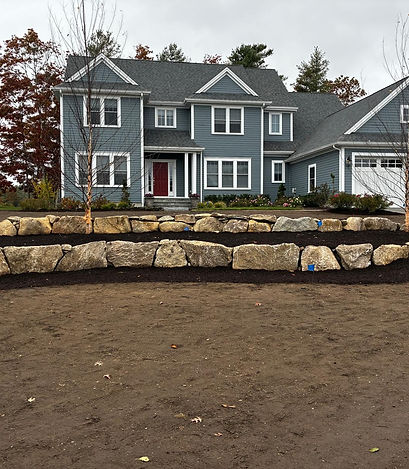
Finish Grading for Lawns
Finish grading creates smooth, even surfaces that are ready for grass. Once rough grading establishes proper drainage and loam is spread, finish grading refines the surface by removing bumps, filling low areas, and creating consistent grades that mow cleanly and evenly.
During finish grading, we remove rocks, roots, and debris that would interfere with mowing or prevent proper seed and sod establishment.
The soil surface is broken down and leveled to create a fine, workable texture that allows grass seed to make solid soil contact and sod to root in quickly. Uneven surfaces, clumps, and buried debris lead to poor germination and long-term lawn issues.
The final grade is carefully matched to surrounding features. Lawns are graded to meet driveways, walkways, patios, and edges at proper elevations, creating clean transitions without gaps or raised edges. Proper tie-ins improve appearance, reduce mowing problems, and give the property a finished, professional look.
Compaction caused by equipment is also addressed during finish grading. We loosen the surface soil to improve root penetration and water infiltration while preserving the drainage slopes established during rough grading. This balance ensures healthy grass establishment without compromising water flow or site drainage.
Yard Regrading
Regrading existing properties fixes drainage and slope problems on landscapes that are already installed. This includes finished yards with water that still floods the basement and pools in low spots.
This costs more than grading correctly during initial installation because the existing landscaping needs to be removed, the grades need to be fixed, and then the landscaping gets reinstalled. Sod gets stripped and saved when possible. Plant beds get cleared. After regrading is complete, everything goes back in better conditions.
We identify problem areas, plan new grades that will fix the problems, and reinstall the landscaping. Completed regrading eliminates water problems and creates a grade that actually works.
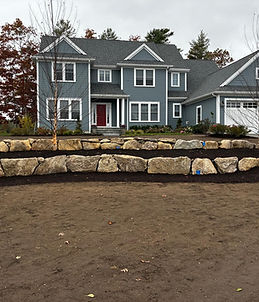

Grading for Hardscaping
Grading for hardscaping creates proper base elevations before patios, walkways, and retaining walls get installed. Hardscaping needs specific grades and elevations to function correctly. Installing on a poorly graded base causes settling, drainage problems, and eventual failure.
Patios need a slight slope so water sheds off instead of pooling on the surface. We grade the subbase with pitch away from buildings, accounting for base material thickness and paver or stone thickness. The final patio surface ends up at the correct elevation with proper drainage that directs water away from the house and down the yard's natural pitch.
Walkways need grading that creates a stable base with proper pitch so water doesn't pool around them. Water trapped under or around walkways causes frost heave and settling. We grade to shed water away from walkway areas before installing base materials.
Retaining walls need proper grading behind them for drainage and in front of them so water doesn't pool. Behind walls, we grade to create drainage zones that prevent water pressure buildup. In front of walls, grading directs water away and down the pitch so it doesn't collect at the wall base. This ties walls into surrounding landscapes while ensuring water flows away from hardscaping.
Soil Quality and Depth
Soil quality determines if plants and grass actually grow or just struggle forever. Poor quality soil means constant fertilization, watering, and watching things barely survive. Quality soil supports healthy growth with normal maintenance.
Screened loam removes rocks, roots, and debris while maintaining soil structure. We use screened loam that's clean enough to work with while having texture that supports plants.
Soil depth matters as much as quality. Lawn areas need a minimum of 4 to 6 inches of quality loam. Planting beds need 8 to 12 inches, depending on what's getting planted. Trees and large shrubs need even more depth for proper root development.
We design plant beds as rounded mounds higher than the surrounding lawn level. This creates visual interest, ensures excellent drainage in beds, and gives plants an elevated growing area with good soil depth. Flat beds at lawn level often collect water and have drainage issues.
pH testing identifies if the soil is too acidic or alkaline for plant growth. Most Fairhaven properties have acidic soil from pine needles or natural conditions. Lime application raises the pH into a range where grass and plants absorb nutrients effectively. Without a correct pH, plants can't use fertilizer even when it's applied regularly.


Equipment and Process
Skid steers and tractors work for most residential loaming and grading. They maneuver in tighter spaces while still moving adequate amounts of soil and loam. Attachments like landscape rakes, buckets, and grading blades let these machines handle rough grading, loam spreading, and finish work.
Hand tools finish details that equipment can't reach. Rakes, shovels, and hand grading create final surfaces around features, along edges, and in tight spots.
A combination of equipment for bulk work and hand finishing for details creates the best results.
The process starts with rough grading that establishes major drainage slopes and elevations. Loam gets delivered and spread to proper depths. Finish grading creates smooth surfaces and final elevations. Each step builds on previous work to create finished grades ready for landscaping installation.
Common Loaming and Grading Problems
Water pooling near foundations happens because the yard slopes toward buildings instead of away. Water seeps into basements or creates foundation damage over time. Proper grading directs water away to correct this.
Yards too steep to mow safely create hazards and make maintenance difficult. Properties on hills or with severe slopes need regrading to create manageable grades or terraced levels. Steep slopes also erode during storms, losing soil and creating channels.
Low spots that stay wet for days after rain make areas unusable and kill grass. Regrading eliminates low spots and creates proper drainage.
Grass that won't grow despite fertilization and watering often struggles because of poor soil. Bringing in quality loam gives grass what it needs.
New construction with improper grading leaves homeowners with drainage problems, unusable slopes, and inadequate soil. Professional loaming and grading fixes these problems and creates a proper foundation for landscaping.
Getting Started with Loaming and Grading
Properties throughout Fairhaven, Rochester, Acushnet, Mattapoisett, Marion, New Bedford, and Dartmouth need loaming and grading that creates a proper foundation for healthy landscapes.
Professional grading prevents water problems and creates functional outdoor spaces with soil that actually supports plant growth.
Call 508-763-8000 or email request@newenglandtreeandlandscape.com. We'll schedule a site visit, assess the grading and soil conditions, and provide solutions to your drainage problems.
35 years in business. Local crew based at 232 Huttleston Avenue in Fairhaven. Family-owned. We're the caring professionals serving the South Coast.
FAQ's
Is loaming and grading a permanent solution or something that requires ongoing maintenance?
Loaming and grading are typically a long-term solution, not something that requires constant maintenance, especially when done correctly from the start. Proper grading establishes correct slopes and drainage, which prevents ongoing water and erosion issues. Minor settling can occur over time, but widespread regrading is not usually needed if the base work and drainage were done right.
What is the difference between grading and leveling a yard?
Grading and leveling are not the same thing. Landscape grading adjusts soil elevations and slopes to direct water away from your home, foundation, and hardscape. The goal is to create a gentle fall so stormwater never pools near structures. Leveling focuses on flattening specific areas for appearance or usability, but it does not address drainage unless grading is part of the process.
At what stage of a larger landscape project should grading be done?
Grading should be the very first step in any landscape project. Proper elevations and drainage need to be established during the design phase so patios, walkways, lawns, and planting areas all sit at the correct height and pitch. Skipping grading early often leads to drainage problems and costly fixes later.
How can soil be stabilized on a sloped area of a yard?
For steep or severe slopes, retaining walls are the most reliable long-term solution. For gentler slopes, other stabilization options include regrading to reduce the slope angle, using erosion control fabric or matting, installing deep-rooted groundcover plants, hydroseeding with tackifiers, or combining loam with structural fill beneath. The right approach depends on slope severity, drainage, and how the area will be used.
What type of soil works best for regrading a residential backyard?
Loam is the best soil for the finished surface because it supports healthy grass and plant growth. Beneath the loam, structural fill is often used for initial grading to build elevation and establish slope. Fill provides stability, while loam creates a nutrient-rich top layer suitable for seeding, sod, or landscaping.